AI Humanizer for Malaysian Researchers Writing in English
AI humanizer for Malaysian researchers. Reduce false AI-detection flags on Malay-influenced English, keep meaning and citations, disclose honestly.

Malaysia's output on research stands at around 36th in the world, and the nation's five designated Research Universities have built their success on systems in which publication counts determine how much funding institutions receive, how far people are promoted, and whether they are eligible for grants. Malaysia's public universities must use the Malaysian Research Assessment (MyRA), which has been compulsory since 2014 and includes 30% weighting for publications. A big and increasing proportion of those publications starts out as an AI-assisted draft. And this is where the AI humanizer for Malaysian researchers earns its place: it helps you rework your own AI-drafted prose so that careful, standard English is less likely to be misread as machine text.
Malaysia scores 581 on the EF English Proficiency Index, which puts it 24th globally in the "High Proficiency" band. That number is a little misleading for academic writing. Writing is one of the weaker component skills, and the country's long history with English produces a particular trap: Malaysian researchers feel fluent because they have used English throughout their education, but still struggle with formal prose due to systematic interference from Malay (no verb conjugation, no articles, no required copula). This is difficult for them to detect.
Here is the uncomfortable part. Those careful, textbook-correct habits are precisely what AI detectors were trained to distrust. A clean methods paragraph with predictable phrasing can score as "AI-generated" even though a human wrote every word. For a researcher facing FRGS obligations and Scopus targets, a false flag is not a minor annoyance. It can stall a submission and cast doubt on legitimate work.
Pemanusiaan teks AI untuk penyelidik Malaysia
Alat pemanusiaan teks AI kami membantu penyelidik Malaysia menerbitkan dalam bahasa Inggeris akademik dengan lebih adil. Ia mengekalkan makna, istilah teknikal, dan rujukan anda, sambil melaraskan irama ayat supaya penulisan bukan penutur asli yang teliti tidak disalah anggap sebagai teks mesin.
In plain English: you keep your argument, your citations, and your voice. The humanizer varies the rhythm and word choice of your own AI-assisted draft so that standard second-language phrasing reads as what it is, the work of a careful human author. It supports Malay alongside more than 60 other languages, which matters in a country where a single research group may think in Malay, Mandarin, or Tamil before writing in English.
Writing in Malay? It is auto-detected and humanized directly
Malaysian researchers often draft in Bahasa Melayu before moving into English, and the humanizer is built for that. Paste Malay text and ProofreaderPro detects the language on its own, then processes it through a language-aware model that keeps your terminology and citations exactly in place. Through pemanusiaan teks AI it runs on your Malay draft as readily as on your English, so nothing has to be translated first. The same detection spans more than sixty languages, each rewritten in its own voice.
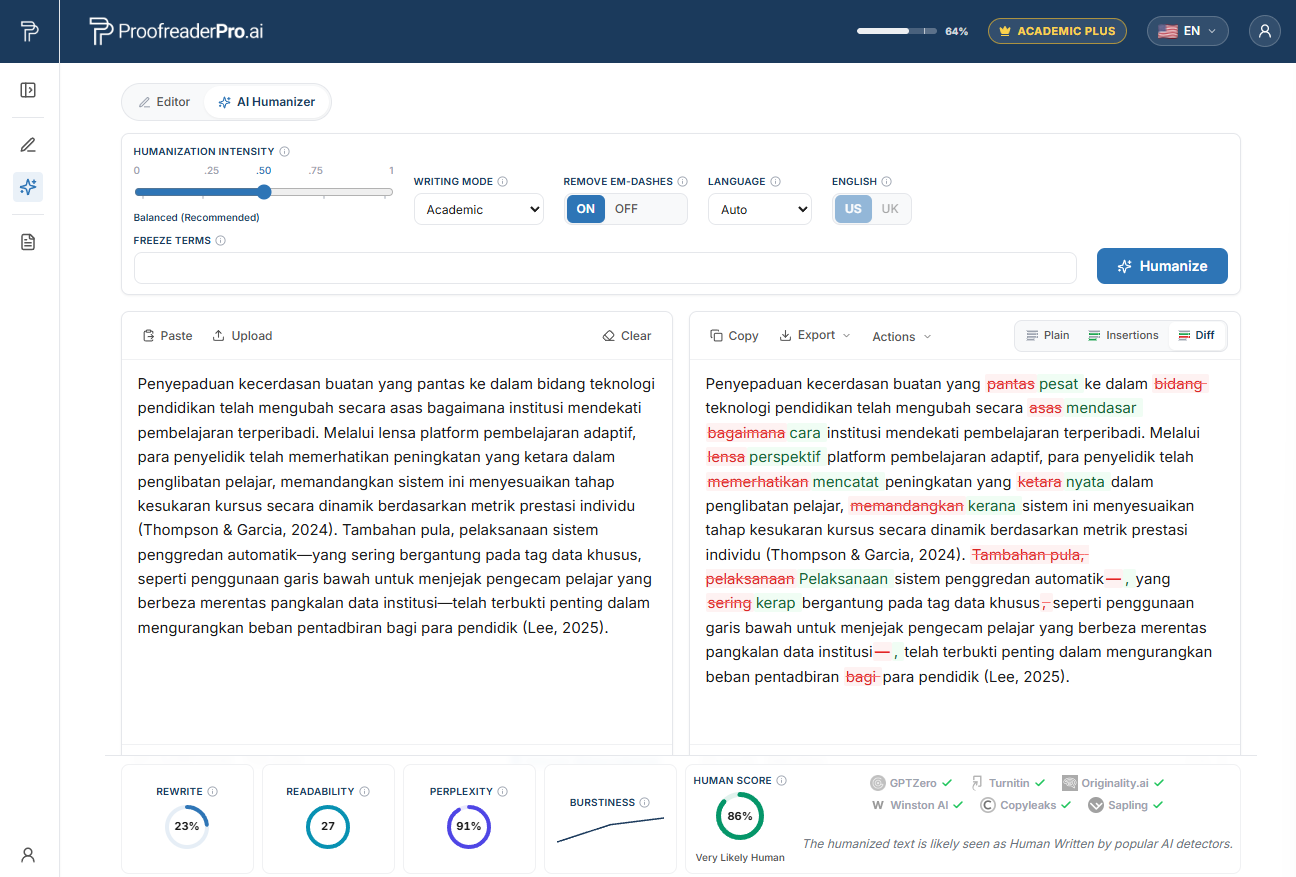
The ProofreaderPro AI Humanizer rewriting Malay academic text. The before and after diff keeps your meaning and citations, and the detector checks confirm a natural, human read.
Why Malaysian researchers get flagged by AI detectors
But the clearest evidence comes from a 2023 Stanford study by Liang and colleagues, that was published in the Cell Press journal Patterns. It's titled "GPT detectors are biased against non-native English writers." They fed human-written TOEFL essays through seven widely used detectors. And on average they found that about 61% of non-native essays got flagged as AI versus about 5% for native English writers. Nearly one in five non-native essays (about 19.8%) got flagged unanimously by all seven detectors. All the essays were written by humans.
The mechanism is called perplexity. Many detectors score how surprising each word choice is to a language model. Careful second-language writers reach for common words and standard, predictable phrasing, which produces low perplexity, which reads as machine text. The very habits that make Malaysian academic prose clear and correct are the habits these tools were built to flag.
This hits Malaysian writing hard because so much of it is deliberately conventional. When you have learned English through formal schooling and academic reading, you write to the template, and the template scores as low perplexity. We explain the full pattern in why AI detectors flag non-native writers. A detector score is a claim to contest, not a verdict.
The Malay first-language patterns behind false flags
Malay is an agglutinative language with no inflectional morphology for tense, number, or agreement. English marks all three. The interference patterns below are correct-sounding, careful, and standard, and that very standardness is part of what pushes perplexity down. Chinese and Tamil-background researchers carry their own transfer patterns too, but Malay is the dominant substrate in most Malaysian academic writing.
Subject-verb agreement. Malay verbs never change with their subject: "Saya pergi," "Dia pergi," and "Mereka pergi" all use the same verb. English demands the third-person "-s" ("the result indicates"), and the correction produces exactly the tidy, expected form a detector rates as unsurprising.
Verb tense. Malay conveys time through aspect markers such as "sudah," "sedang," and "akan" rather than conjugation. Malaysian writers correcting toward a consistent past-tense methods section ("we collected the samples and analyzed them") land on the most standard, most predictable phrasing available.
Article use. Malay has no "the" or "a/an." Learning to insert them correctly ("the method was validated," "this study proposes a framework") pushes prose toward the conventional determiner patterns that read as low perplexity.
Copula omission. In Malay the copula is routinely dropped: "Dia guru" means "She is a teacher" with no linking verb. Restoring "is" in English ("the result is significant at p < 0.05") yields the plain, textbook construction detectors expect.
Plural marking and prepositions. Malay marks plurals through reduplication ("buku-buku") and maps one preposition ("di") onto English "in," "at," and "on." Correcting to "three respondents" or "interested in" produces standard collocations, which is good writing and, unfortunately, low-perplexity writing.
None of these are errors once corrected. They are the marks of a diligent non-native author, and a fair evaluation should treat them that way.
Malaysia's AI-detection and Turnitin context
Theses and journal submissions across Malaysia are commonly screened with Turnitin or iThenticate for similarity, and increasingly for AI indicators. Postgraduate candidates at the Research Universities routinely run chapters through these tools before submission, and journals apply the same checks at the manuscript stage.
It's worth remembering how contested these AI scores are. Vanderbilt disabled Turnitin's AI detector in 2023, citing false positives and bias against non-native writers. Michigan State, UT Austin, Northwestern, Pittsburgh, SMU, and Waterloo followed suit. Turnitin itself suppresses scores in the 1 to 19% range (showing an asterisk rather than a number) and warns that its score should not be used alone to make an integrity decision.
At the same time, funders and journals increasingly ask authors to disclose AI use. The straightforward path is not to hide anything. It is to humanize your own draft for fairness, keep your meaning and citations intact, and then disclose your AI use the way your institution and target journal require.
Humanize your own AI-assisted draft, then disclose
Rework your careful Malay-influenced English so detectors read it fairly, with your meaning, terminology, and citations kept intact. Cuba percuma.
Try the Humanizer FreeTop Malaysian universities and where AI checks appear
These institutions screen theses and manuscripts for similarity and AI indicators. The list keeps local-language names where the source uses them.
- Universiti Malaya (UM), Kuala Lumpur. Malaysia's oldest and highest-ranked university and its leading producer of high-impact publications.
- Universiti Kebangsaan Malaysia (UKM), Bangi, Selangor. The national university, strong across science, medicine, and Malay studies.
- Universiti Putra Malaysia (UPM), Serdang, Selangor. Comprehensive, with leading research in agriculture, forestry, and biotechnology.
- Universiti Sains Malaysia (USM), Penang. Malaysia's APEX university, strong in pharmaceutical sciences and engineering.
- Universiti Teknologi Malaysia (UTM), Johor Bahru. The premier technical university, strong in engineering and the built environment.
- Universiti Teknologi MARA (UiTM), Shah Alam, Selangor. Malaysia's largest university, with wide output across applied sciences and business.
- International Islamic University Malaysia (IIUM), Gombak, Selangor. Strong in Islamic studies, law, engineering, and medicine.
- Universiti Utara Malaysia (UUM), Sintok, Kedah. The management university, leading in business, economics, and public management.
- Taylor's University, Subang Jaya, Selangor. The top-ranked private university, with a growing Scopus footprint.
- UCSI University, Kuala Lumpur. Private university with strengths in pharmacy, engineering, and business.
- Sunway University, Subang Jaya, Selangor. Private university with growing strength in biological sciences and computing.
- Universiti Malaysia Sarawak (UNIMAS), Kota Samarahan, Sarawak. East Malaysia's leading university for biodiversity and tropical environmental science.
Across all of these, promotion, tenure, and funding are tied to Scopus and Web of Science publication counts, so a manuscript that survives an AI check on the first pass saves real time.
How the AI humanizer for Malaysian researchers works
The workflow is simple and clear. Draft your paper, optionally starting in Malay and translating your notes into English. Proofread the grammar so the argument is clean. Then run your own AI-assisted prose through the humanizer so that careful non-native writing is less likely to be misread, with your meaning, technical terms, and citations preserved. You can start from the text humanizer and keep everything in one place.
Our humanizer reworks AI text into a more natural human form that reads as human across Turnitin, Originality.ai, and GPTZero, while keeping grammar accuracy high on academic text. (The scores are from testing and do not represent any promises or guarantees; detectors retrain every few months.) We never promise a score. The point is to give clear, careful writing a fairer reading, not to disguise anything.
The final step is disclosure. Once your language reads naturally, state your AI use in the format your institution and journal expect. That combination, humanize plus disclose, keeps you inside integrity rules while protecting your work from a false flag. If your draft still needs grammar and structure help first, our academic editing for Malaysian researchers guide covers that side, and this post sits inside our broader multilingual AI humanizer hub.
Local funding bodies, journals, and AI-disclosure expectations
Malaysia's competitive funding runs largely through the Fundamental Research Grant Scheme (FRGS), which typically requires Web of Science indexed publications as a condition of the grant, and the whole system feeds into MyRA, the assessment that carries publications at 30% weight. Most universities administer these through a Research Management Centre (RMC), and language-editing costs are commonly recognized as legitimate publication-support expenses.
On the journal side, Malaysia hosts several respected English-language venues that apply real language-quality standards:
- Pertanika Journal of Tropical Agricultural Science (JTAS), published by UPM.
- Pertanika Journal of Science and Technology (JST), published by UPM.
- Pertanika Journal of Social Sciences and Humanities (JSSH), published by UPM.
- Sains Malaysiana, published by UKM and indexed in SCIE.
- Malaysian Journal of Medical Sciences, published by USM.
- Asian Journal of University Education, published by UiTM.
These journals, along with the Scopus and Web of Science venues that FRGS projects target, increasingly expect an AI-use disclosure alongside a clean manuscript. Disclosing that you used an AI assistant and a humanizer to polish your own writing is fully compatible with integrity rules. Hiding it is not. When you disclose openly, a text humanizer is simply part of a modern, transparent writing process.
Frequently asked questions
Q: Is the AI humanizer for Malaysian researchers a way to cheat Turnitin?
No. It is a fairness tool for your own AI-assisted writing, not a way to disguise fabricated or borrowed work. You keep your meaning and citations, improve the rhythm of careful non-native English, and then disclose your AI use as your university and journal require. That is the opposite of hiding something.
Q: Will pemanusiaan teks AI change my citations or technical terms?
No. The humanizer preserves your references and your discipline-specific terminology while it varies sentence rhythm and word choice. It targets the repetitive, low-perplexity cadence that trips detectors, not the substance of your argument or your evidence.
Q: Why does my correct English get flagged as AI in the first place?
Because many detectors score perplexity, and careful second-language writers use common words and predictable phrasing that reads as low perplexity. The 2023 Stanford study found about 61% of human-written non-native essays flagged as AI, versus about 5% for native writers. Your standard, textbook-correct prose is exactly what these tools were trained to distrust.
Q: Can I use FRGS or university funds for editing and humanizing tools?
Language editing is generally treated as a recognized research expense under FRGS and most Malaysian university grants, since it supports the WoS and Scopus publications that MyRA and promotion require. Check your specific grant terms or ask your Research Management Centre, which usually classifies such tools under publication support.
Q: Does the humanizer work if I draft in Malay first?
Yes. Many Malaysian researchers think and note in Malay before writing in English. You can draft in Malay, translate into academic English, proofread, and then humanize the result, all while keeping meaning and citations stable. The model is language-aware and preserves sentence structure across more than 60 languages.
Give careful, Malay-influenced English a fairer reading from AI detectors. Keep your meaning, terminology, and citations, then disclose your AI use with confidence.

Moe is an NLP engineer with a PhD in natural language processing. His research covers computational linguistics, text analysis, and machine learning, and it fed directly into the editing and humanization models behind ProofreaderPro. He writes about the part of the process most people never see: how a language model reads a sentence, scores it, and decides what to change.