AI Humanizer for Kazakh Researchers Writing in English
AI humanizer for Kazakh researchers. Reduce false AI-detection flags on Kazakh and Russian influenced English, keep meaning and citations, disclose honestly.

Kazakhstan produces around 7,600 Scopus-indexed papers a year and sits near 64th in the world for research output, a number climbing fast because careers now depend on it. A PhD candidate cannot defend a dissertation without at least one Scopus publication carrying a positive impact factor. An associate professor (dotsent) needs two, a full professor three. Nearly every one of those papers has to be written in English. An AI humanizer for Kazakh researchers exists for one narrow, real reason: careful English written by a Kazakh or Russian speaker is increasingly misread by automated detectors as machine text, and that misreading can cost you a submission.
Kazakhstan scores 427 on the EF English Proficiency Index, ranking 103rd in the "Very Low Proficiency" band. Most researchers were educated primarily in Kazakh or Russian and learned English later, often through self-study. Reading English papers is one skill. Producing a publication-ready manuscript that satisfies international reviewers is a much harder one, and the country's research support has not caught up with the publish-or-perish mandate.
Here's the trap. When a Kazakh scientist writes clean, standard, textbook-correct English, the very predictability of that prose is what an AI detector reads as "generated." The habits that make second-language writing clear are the habits detectors were trained to flag. That isn't a Kazakhstan problem alone, but the trilingual reality here makes it sharper.
Қазақстандық зерттеушілерге арналған AI мәтінін адамдандыру
ProofreaderPro.ai жәрдемдеседі: our humanizer helps Kazakh researchers publish careful, natural English in international journals without being falsely flagged as AI. It works on your own AI-assisted draft, keeps your meaning and citations intact, and reads naturally to a human reviewer.
Kazakhstan's research runs on two scientific languages, not one. Kazakh (Қазақ тілі) is the state language, and Russian (русский язык) remains a working language of science across most laboratories and older faculties. Many researchers draft their reasoning in Russian or Kazakh, translate, then polish in English. Our humanizer sits at the end of that pipeline, after your meaning is settled, to protect legitimate work from a false positive.
Drafting in Kazakh or Russian? The humanizer detects each one
Kazakhstani researchers often work in Kazakh or Russian before writing up in English, and the humanizer supports both directly. Paste Kazakh text and ProofreaderPro recognises the Cyrillic script automatically, then routes it through a language-aware model that keeps your terminology and citations exactly as written. Through AI мәтінін адамдандыру your Kazakh draft is humanized as readily as your English, with nothing translated first. And because detection spans more than sixty languages, a Russian draft is recognised and humanized just as readily.
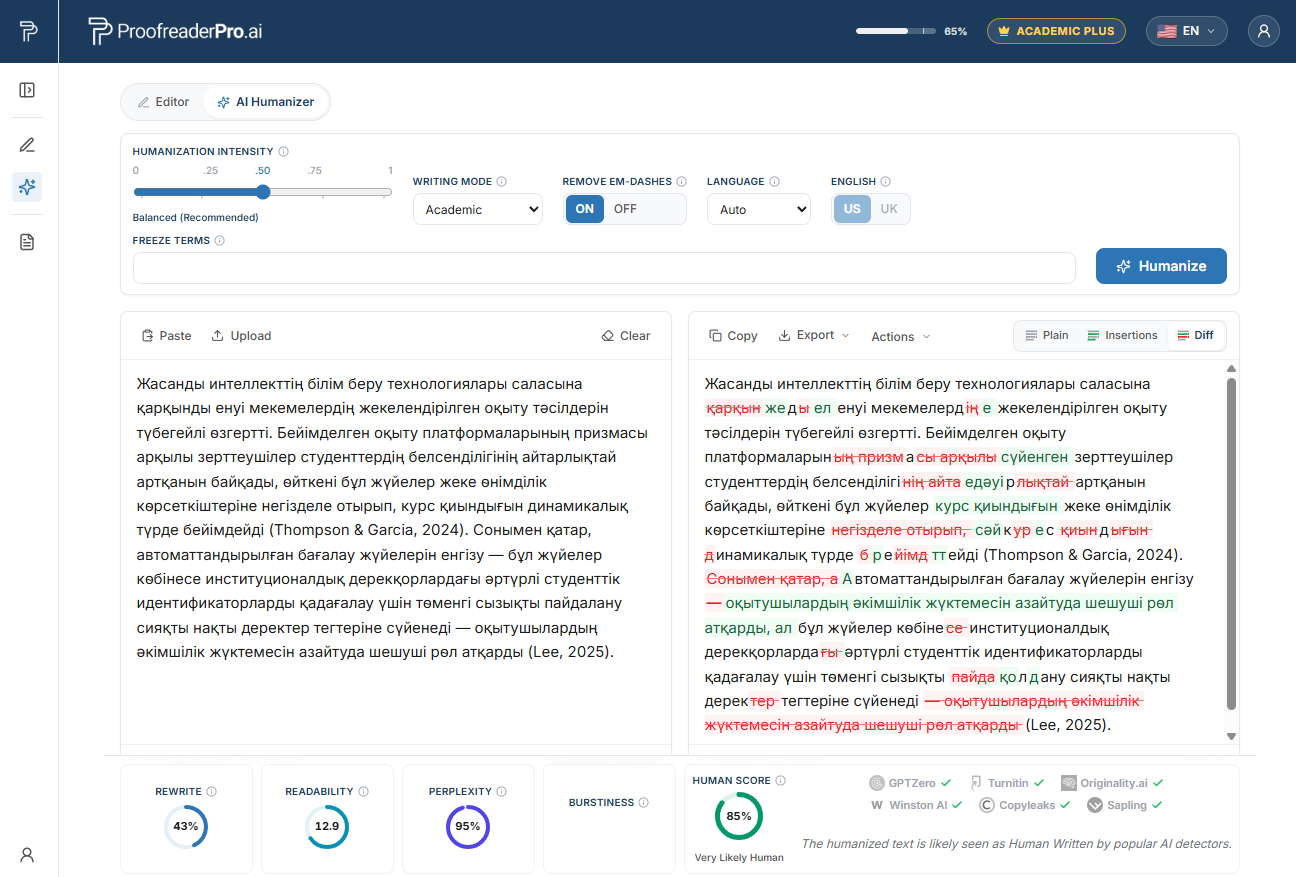
The ProofreaderPro AI Humanizer rewriting Kazakh academic text. The before and after diff keeps your meaning and citations, and the detector checks confirm a natural, human read.
Why Kazakh researchers get flagged by AI detectors
In 2023, a Stanford team led by Weixin Liang published a study in the Cell Press journal Patterns titled "GPT detectors are biased against non-native English writers." They ran human-written TOEFL essays through seven widely used detectors. On average, about 61% of the non-native essays were flagged as AI, against about 5% for native English writers. Nearly one in five non-native essays (about 19.8%) was flagged unanimously by every detector. Every single essay was written by a human.
The mechanism is perplexity. Many detectors score how "surprising" each next word is to a language model. A careful second-language writer chooses common words and standard, predictable phrasing, which produces low perplexity, which reads as machine text. A Kazakh researcher who has drilled formal English to avoid mistakes ends up writing exactly the smooth, low-variation prose the detector treats as a red flag. We explain the full mechanism in why AI detectors flag non-native writers.
The Kazakh and Russian first-language patterns behind false flags
The linguistic situation here is unusual: most researchers carry interference from two typologically distinct languages at once. Kazakh is Turkic, agglutinative, and Subject-Object-Verb. Russian is Slavic with a rich case system. Neither has articles. The point below is not that these patterns are errors to be ashamed of. It is that the corrected, careful versions of these constructions are standard, low-perplexity English, which is precisely what a detector reads as generated.
Article discipline. Neither Kazakh nor Russian has "a," "an," or "the," so Kazakh writers learn the article system as an abstract rule and then apply it very consistently. "We conducted an experiment to measure the temperature of the solution" is textbook-correct, and that textbook regularity is exactly what scores as low perplexity.
SOV word order, then over-correction. Kazakh places the verb last ("Men kitapty oqydym," literally "I book-the read"). Writers who know English is SVO tend to rebuild sentences into a clean, canonical order to be safe. Uniform, well-formed sentence architecture reads as predictable to a detector.
Copula restoration from Russian. Russian drops "to be" in the present ("Eta metod effektiven," "this method [is] effective"). Kazakh writers learn to insert the copula everywhere: "This method is effective for detecting outliers." Correct, and evenly patterned.
Prepositions learned as fixed pairs. Russian uses cases where English uses prepositions, so writers memorize "depends on," "consists of," "results in," and "participates in" as set phrases and deploy them uniformly. Consistent collocations are, again, low-variation text.
Unstacked noun phrases. Kazakh stacks meaning through suffixes. Careful writers unpack this into measured English ("an analysis of the efficiency of the temperature control system"). The result is grammatical, formal, and smooth.
Tense regularity. Because neither language maps cleanly onto English tense and aspect, writers standardize: simple past for methods, present perfect for ongoing relevance. Standardization reduces surprise, and reduced surprise is what the detector penalizes.
None of these constructions is wrong. They are the marks of a disciplined second-language writer, and a fair review process should never treat that discipline as evidence of cheating.
Kazakhstan's AI-detection and Turnitin context
Theses and journal submissions from Kazakhstan are commonly screened with Turnitin or iThenticate for similarity, and AI indicators now travel alongside those similarity scores. Kazakh universities have leaned hard into international publishing, so screening tools imported with that push are increasingly part of the workflow at defense and at submission.
It is worth being clear about what these scores are. Turnitin itself suppresses AI scores in the 1 to 19% range (showing an asterisk rather than a number) and warns that the score should not be used alone for an integrity decision. Vanderbilt disabled Turnitin's AI detector in 2023, citing false positives and bias against non-native writers, and Michigan State, UT Austin, Northwestern, Pittsburgh, SMU, and Waterloo took similar steps. A detector flag is a claim to contest, not a verdict.
At the same time, funders and journals increasingly ask authors to disclose how they used AI tools. Those two facts are not in tension. The straightforward path is to write real work, protect it from false flags, and disclose your tool use openly.
Protect careful English from a false AI flag
Humanize your own AI-assisted draft, keep your meaning, citations, and technical terms, and disclose your tool use the way your journal requires. Built for Kazakh and Russian speakers writing for Scopus.
Try the Humanizer FreeTop Kazakhstan universities and where AI checks appear
Research output is concentrated in a small number of flagship institutions, most of them in Astana, Almaty, and a few regional centers. Each of these screens theses and manuscripts for similarity and AI indicators as part of defense and submission.
- Nazarbayev University (NU), Astana, the flagship English-medium university with international partnerships
- Al-Farabi Kazakh National University (KazNU), Almaty, the oldest and largest national university and top Scopus producer
- Satbayev University (Kazakh National Research and Technical University), Almaty, the leading technical university
- L.N. Gumilyov Eurasian National University (ENU), Astana, strong in natural sciences and engineering
- Kazakh-British Technical University (KBTU), Almaty, partially English-medium, petroleum and IT
- KIMEP University, Almaty, English-medium in business, economics, and law
- Karaganda University (Ye.A. Buketov Karaganda University), Karaganda, chemistry, physics, and education
- South Kazakhstan University (M. Auezov South Kazakhstan University), Shymkent, chemical engineering and agricultural sciences
- Turan University, Almaty, a private university with growing research output
- International Information Technology University (IITU), Almaty, computer science and digital technologies
Researchers at Nazarbayev University tend to have the strongest English, yet even there a careful manuscript can trip an AI flag. At Kazakh-medium and Russian-medium institutions, where English is a later-acquired language, the false-positive risk is higher precisely because the writing is so consistently correct.
How the AI humanizer for Kazakh researchers works
The workflow is clear and simple. Draft your paper, in Russian or Kazakh first if that is where your reasoning flows, then translate into English. Fix the grammar so the meaning is exactly what you intend. Then run your own AI-assisted English through the humanizer so that careful, low-variation prose is less likely to be misread by a detector. Your citations (APA, MLA, Chicago, IEEE, Vancouver), your numbers, and your technical terminology are preserved. What changes is rhythm and word choice: the humanizer varies cadence, breaks repetitive patterns, and removes tells like stray em dashes.
Tested against the major detectors, our text humanizer rewrites AI text into a more natural human form, which lowers the AI signal and improves its odds against tough detectors, while keeping grammar accuracy high on academic text. Those are results from testing, not guarantees. Detectors retrain every few months, so we never promise a number and never claim your text will be "100% undetectable." The goal is fairness for real work, not a trick.
Then disclose. Add an AI-use statement in the format your institution and target journal require. Humanizing your own draft and disclosing your tool use are not opposites: together they keep you inside integrity rules while protecting genuine second-language writing from a false flag. If you want the general mechanics across languages, see the multilingual AI humanizer hub. If your manuscript needs grammar and structure fixed before humanizing, that belongs to academic editing for Kazakh researchers.
Local funding bodies, journals, and AI-disclosure expectations
The Ministry of Science and Higher Education sets and periodically tightens the Scopus publication requirements that gate every rung of the academic ladder, and the National Academy of Sciences of the Republic of Kazakhstan anchors much of the country's multidisciplinary output. Many universities offer cash bonuses for Scopus papers, which raises the stakes on every single submission and makes a language-driven desk rejection especially costly.
Domestic journals are moving toward English and toward international indexation. Prominent titles include the Eurasian Journal of Mathematical and Computer Applications, the Central Asian Journal of Medical Hypotheses and Ethics, the Chemical Bulletin of Kazakh National University (Al-Farabi KazNU), the Eurasian Physical Technical Journal, the International Journal of Biology and Chemistry (Al-Farabi KazNU), and the Reports of the National Academy of Sciences of the Republic of Kazakhstan. Whether you target these or a Q1 international journal, English quality is the shared gate, and more of them now expect an explicit note on any AI assistance.
Our advice stays constant: humanize your own draft with the text humanizer, keep your citations exact, and write a clear disclosure statement. That is the version of this workflow that survives a reviewer, a supervisor, and your own conscience.
Frequently asked questions
Q: Is using an AI humanizer for Kazakh researchers considered cheating?
No, not when you use it responsibly. You humanize your own AI-assisted draft, you keep your meaning and citations, and you disclose your AI use in the format your institution and journal require. That is language support that protects real work, not a way to hide fabricated content or pass off someone else's writing.
Q: Will the humanizer guarantee my paper passes Turnitin or GPTZero?
No. Tested against the major detectors, it rewrites AI text into a more natural human form, which lowers the AI signal and improves its odds against tough detectors, with high grammar accuracy on academic text. Those are test results, not promises. Detectors retrain often, so no credible tool can guarantee a score or claim your text is 100% undetectable.
Q: Does it work on Kazakh and Russian influenced English?
Yes. The humanizer supports more than 60 languages and routes non-English influenced prose through a language-aware model that preserves sentence structure and meaning. For bilingual Kazakh and Russian speakers, it varies the smooth, low-perplexity rhythm that detectors misread while keeping your scholarly tone and technical terms.
Q: Why do careful Kazakh writers get flagged more than sloppy ones?
Because detectors score predictability, not quality. A Stanford study found about 61% of human-written non-native essays flagged as AI, against about 5% for native writers. The disciplined, standard, article-correct English that a strong Kazakh researcher produces is exactly the low-perplexity text a detector treats as machine-generated.
Q: What should I do if my manuscript is flagged after I humanized and disclosed it?
Treat the flag as a claim to contest, not a verdict. Turnitin itself says its score should not be used alone for integrity decisions, and several universities have disabled AI detection over false positives. Keep your drafts and notes, share your disclosure statement, and explain your workflow to the reviewer or committee.
A language-aware humanizer for Kazakh and Russian speakers: vary the rhythm detectors misread, preserve meaning and references, then disclose your AI use with confidence.

Moe is an NLP engineer with a PhD in natural language processing. His research covers computational linguistics, text analysis, and machine learning, and it fed directly into the editing and humanization models behind ProofreaderPro. He writes about the part of the process most people never see: how a language model reads a sentence, scores it, and decides what to change.