AI Humanizer for Italian Researchers Writing in English
AI humanizer for Italian researchers. Reduce false AI-detection flags on Italian-influenced English, keep meaning and citations, disclose honestly.

Italy sits among the world's top eight to ten countries for research output, yet almost none of that work reaches its readers in Italian. Academics here draft and think in one language and publish in another, because an Italian research career runs through indexed English-language journals. The VQR research-quality assessment and the ASN national qualification for professorship both lean on bibliometric thresholds in Scopus and Web of Science, so an English paper in the right journal is not optional.
That pressure now collides with a newer problem. An AI humanizer for Italian researchers exists because careful, correct second-language English is the exact kind of prose that AI detectors mistake for machine writing. Your colleague did the work, wrote every word, and still got flagged.
This guide is about fairness, not disguise. The goal is to humanize your own AI-assisted draft, keep your meaning and citations intact, and then disclose your AI use the way your institution and journal require.
Un umanizzatore di testo IA per i ricercatori italiani che pubblicano in inglese
Il nostro umanizzatore di testo IA aiuta i ricercatori italiani a pubblicare in inglese senza che una scrittura corretta venga scambiata per testo generato da una macchina. Preserva il significato, la terminologia tecnica e le citazioni, e varia il ritmo e le scelte lessicali.
In plain terms: you write the science, and the tool smooths the statistical fingerprint that makes standard non-native prose read as synthetic. Nothing about your argument, your data, or your references changes. What changes is the even, predictable cadence that some detectors treat as a machine signature.
Drafting in Italian? The humanizer detects and rewrites it directly
You can humanize an Italian draft without translating it into English first. Paste your text and ProofreaderPro detects the language automatically, then routes it through an Italian-aware model that keeps accents, terminology, and citations in place. As an umanizzatore di testo IA it varies the rhythm of your Italian prose while preserving every finding and reference. Automatic detection reaches across more than sixty languages, so Italian is treated as Italian rather than reshaped into English.
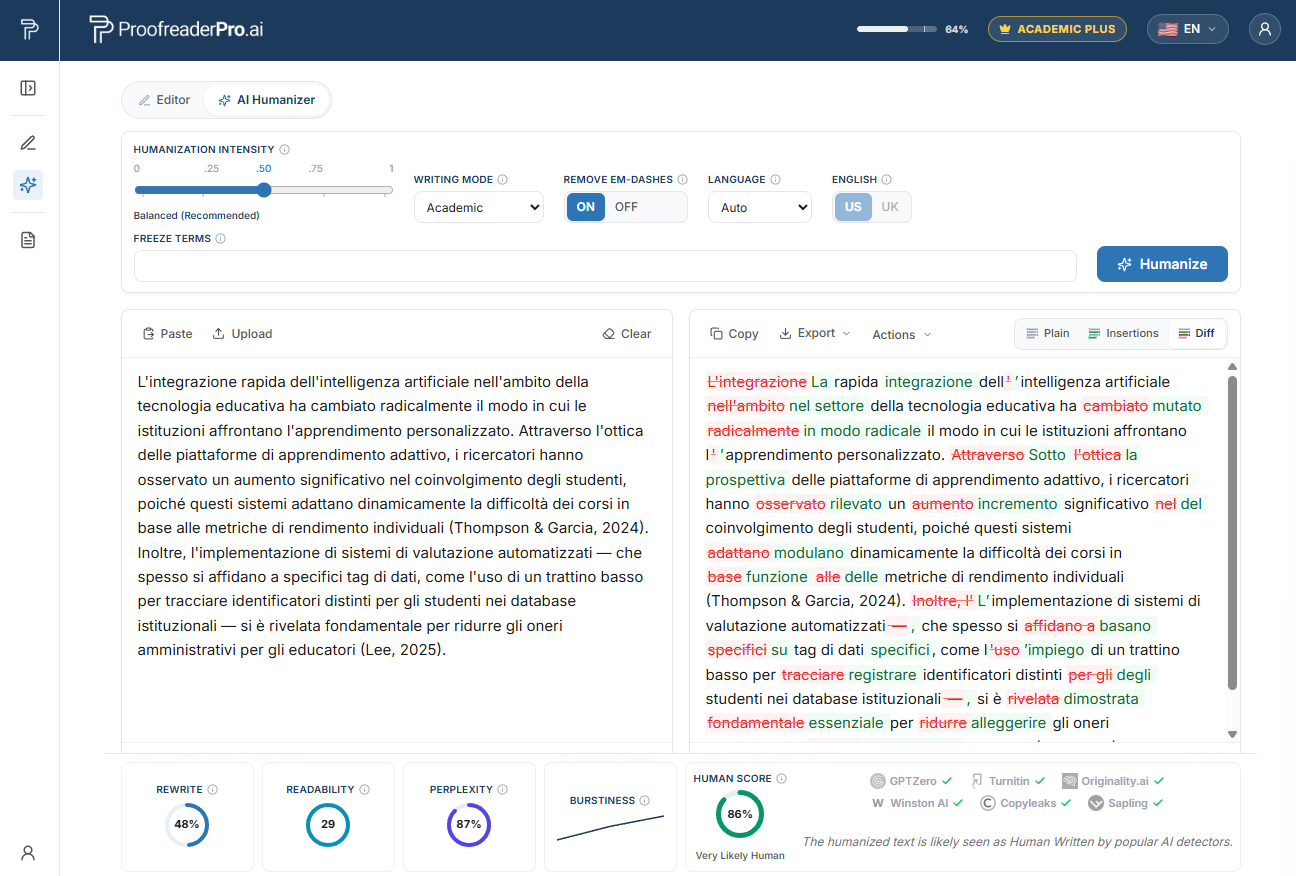
The ProofreaderPro AI Humanizer rewriting Italian academic text. The before and after diff keeps your meaning and citations, and the detector checks confirm a natural, human read.
Why Italian researchers get flagged by AI detectors
In 2023, a Stanford team led by Liang and colleagues published a study in the Cell Press journal Patterns with a blunt title: GPT detectors are biased against non-native English writers. They ran human-written TOEFL essays through seven widely used detectors.
The result should worry anyone publishing in a second language. On average, about 61% of the non-native essays were flagged as AI, against about 5% for native writers. Nearly one in five, about 19.8%, was flagged unanimously by every detector. Every one of those essays was written by a human.
The mechanism is called perplexity. Detectors measure how surprising each word choice is to a language model. Careful second-language writers reach for common words and standard, predictable phrasing, which produces low perplexity, which reads as machine text. The habits that make your English clear are the same habits these tools were trained to punish. We break this down further in why AI detectors flag non-native writing.
The Italian first-language patterns behind false flags
None of the patterns below is an error. They are the careful, textbook constructions an Italian scholar reaches for, and that very regularity is what a detector reads as low perplexity.
Long hypotactic sentences. Italian academic style favors long periods with several nested subordinate clauses. Rendered into English they stay grammatical but grow dense, and their even, over-qualified rhythm looks predictable to a model.
Articles with abstract nouns. Writing the nature, the science, or the society, where English usually drops the article, is a direct and consistent transfer from Italian. That consistency is precisely the signal detectors reward with a low score.
Preposition transfer. Depend from for dipendere da, or on the basis of in place of based on, are systematic, rule-governed choices. Systematic choices are, by definition, low perplexity.
Nominalization and Latinate diction. Heavy noun phrases such as the realization of the analysis, and a steady preference for Latinate vocabulary, are standard formal register. Formal and standard is exactly what these tools flag.
Calqued connectors. Frequent sentence-initial Moreover, Furthermore, and In fact, mirrored from Italian discourse markers, add a regular, repetitive cadence that reads as machine-smooth.
False friends. Attualmente pushed toward actually rather than currently, or eventualmente toward eventually rather than possibly, are the corrections a careful writer makes toward the most standard-looking word. The most standard word is also the least surprising one.
Italy's AI-detection and Turnitin context
Italian theses and manuscripts are routinely screened for textual similarity, most often with Turnitin or iThenticate, and those tools increasingly surface AI indicators alongside the familiar similarity score. A similarity report is normal practice at doctoral schools and in editorial workflows, and by itself it says nothing about your integrity.
Two things are worth keeping in perspective. First, an AI indicator is a claim, not a verdict. Turnitin itself suppresses scores in the 1 to 19% range and warns that its number shouldn't decide an integrity case on its own. Several universities, including Vanderbilt, Michigan State, and UT Austin, disabled the AI detector entirely, citing false positives and bias against non-native writers.
Second, the direction of travel in Italy, as elsewhere, is toward disclosure. Funders and journals increasingly ask you to state where and how you used AI. That expectation is your protection: full disclosure, not a spotless detector score, is what keeps you inside the rules.
Protect your own writing from a false flag
Humanize your AI-assisted draft in minutes, keep every citation, then disclose. Built for careful non-native academic English.
Try the Humanizer FreeTop Italian universities and where AI checks appear
The screening described above happens across Italy's leading institutions. Doctoral schools and editorial offices at these universities run theses and manuscripts through similarity checks, and increasingly weigh AI indicators too:
- Sapienza Università di Roma, in Rome
- Università di Bologna (Alma Mater Studiorum), in Bologna
- Politecnico di Milano and Università degli Studi di Milano (Statale), in Milan
- Università degli Studi di Padova, in Padua
- Università degli Studi di Napoli Federico II, in Naples
- Politecnico di Torino and Università degli Studi di Torino, in Turin
- Università di Pisa, Scuola Normale Superiore, and Scuola Superiore Sant'Anna, in Pisa
- Università degli Studi di Firenze, in Florence
- Università degli Studi di Trento, in Trento
- Università Cattolica del Sacro Cuore, in Milan
At every one of them, a flag is the start of a conversation about your methods, not a conclusion about your honesty. Knowing that these checks are routine is a reason to prepare, not to panic.
How the AI humanizer for Italian researchers works
Here is the workflow, and the order matters.
First, draft your argument. Write in Italian if that is where your thinking is sharpest, then translate, or draft directly in English. Either way, the ideas and the data are yours.
Second, fix the grammar. Correct the false friends, the prepositions, and the article slips so the language is clean before anything else touches it. Our proofreading tools are built for exactly this, and you can see the sibling workflow in AI proofreading for Italian academics.
Third, humanize your own prose. Run your AI-assisted draft through the AI text humanizer. It varies rhythm and word choice and removes the repetitive, low-perplexity cadence that trips detectors, while preserving your meaning, technical terminology, and citations.
The humanizer is tested against the major detectors, and it reworks AI text into a more natural human form that reads as human on Turnitin, Originality.ai, and GPTZero, while keeping grammar accuracy high on academic text. The results are from testing, not promises. We do not promise to bypass anything, as detectors retrain every few months.
Fourth, disclose. State your AI use in the format your institution and target journal require. That final step is what separates fair protection of real work from disguise.
This post is one stop in our multilingual AI humanizer hub, which covers the same workflow for researchers writing from other first languages. If your larger need is full language editing rather than detector fairness, start at our global academic editing hub.
Local funding bodies, journals, and AI-disclosure expectations
Italian research funding and assessment run through a handful of bodies, and each one raises the stakes on where your work is published.
The MUR (Ministero dell'Università e della Ricerca) funds universities and national grants. PRIN (Progetti di Ricerca di Rilevante Interesse Nazionale) is the main competitive national scheme. The CNR (Consiglio Nazionale delle Ricerche) is the country's largest public research body. ANVUR runs both the VQR assessment and the ASN qualification, and it maintains the class-A journal lists that carry real weight in the humanities and social sciences.
For placement, that means Scopus and Web of Science indexing, and ANVUR class-A status in non-bibliometric fields. Manuscripts headed to those journals are screened with Turnitin or iThenticate, and a growing number of journals and funders ask for an explicit AI-use statement. Prepare that statement early, and if a detector ever flags clean work, treat the report as contestable evidence rather than a ruling. A final pass through the AI text humanizer before submission gives careful non-native prose a fairer reading, and your disclosure keeps the whole process transparent.
Frequently asked questions
Q: Is using an AI humanizer for Italian researchers a form of cheating?
No, not when you use it on your own work. You wrote the research; the tool only varies the rhythm and word choice of careful non-native prose so it is less likely to be misread as machine text. The rule that keeps it transparent is disclosure: you still tell your institution and journal how you used AI.
Q: Will the humanizer change my citations or technical terms?
No. It preserves your references, your data, and your discipline's terminology. It targets the low-perplexity cadence that detectors react to, not the substance of your argument.
Q: Can you guarantee my paper will pass Turnitin or GPTZero?
No, and be wary of any tool that promises it. In our testing the humanizer rewrites AI text into a more natural human form, which lowers the AI signal and improves its odds against tough detectors, but detectors retrain constantly, so we report tested results rather than guarantees.
Q: Why does my correct English get flagged at all?
Because detectors score how predictable your word choices are. Standard, textbook Italian-to-English constructions, from article use to Latinate diction, are highly predictable, which reads as low perplexity, which some tools treat as a sign of AI. It is a documented bias against careful second-language writing, not a judgment on your work.
Q: What should I do if a committee or journal flags my writing?
Stay calm and treat the flag as a claim to answer, not a verdict. Keep your drafts and notes, point to the documented bias against non-native writers, and share your AI-use disclosure. A detector score is contestable evidence, never proof.
Give your careful non-native English a fairer reading. Preserve meaning and citations, reduce false AI flags, then disclose with confidence.

Moe is an NLP engineer with a PhD in natural language processing. His research covers computational linguistics, text analysis, and machine learning, and it fed directly into the editing and humanization models behind ProofreaderPro. He writes about the part of the process most people never see: how a language model reads a sentence, scores it, and decides what to change.