AI Humanizer for Indonesian Researchers Writing in English
AI humanizer for Indonesian researchers. Reduce false AI-detection flags on Indonesian-influenced English, keep meaning and citations, disclose honestly.

Indonesia is now the dominant research producer in ASEAN. In 2020 alone its universities published 50,868 Scopus-indexed papers, a 584% increase over 2015, and the country's 303,067 lecturers write under constant pressure to appear in English-language international journals. Many now draft with ChatGPT, Claude, or Gemini to close the language gap, then hit a new problem: AI detectors flag their careful, human-written English as machine text. An AI humanizer for Indonesian researchers exists for exactly this situation, and this guide explains how to use one responsibly.
Indonesia scores 471 on the EF English Proficiency Index, 80th globally in the "Low Proficiency" band. That number says nothing about the quality of Indonesian science. It reflects the structural distance between Bahasa Indonesia and English: no tense system, no articles, no plural inflection, no required copula. When Indonesian researchers write academic English, they write carefully and predictably, and that very carefulness is what a perplexity-based detector reads as artificial.
Here is the unfair part. The habits that make your English clear to a reviewer at UGM Yogyakarta or ITB Bandung are the same habits a detector was trained to score as "AI." A humanizer does not hide your work. It restores the natural variation that careful second-language writing tends to flatten, so a genuine draft is judged on its ideas rather than its sentence rhythm.
Humanizer AI untuk peneliti Indonesia yang menerbitkan dalam bahasa Inggris
Layanan humanizer AI kami membantu peneliti Indonesia menerbitkan karya mereka dalam bahasa Inggris tanpa ditandai secara keliru oleh detektor AI. In plain terms: our humanizer works on your own AI-assisted draft, keeps your meaning, your technical vocabulary, and every citation in place, and then varies the rhythm and word choice that detectors latch onto. The goal is fairness for genuine Indonesian research, not disguise.
For researchers who think and draft more fluently in Bahasa Indonesia, the right path is the same. Write your ideas down, translate, proofread the grammar, then humanize your own prose with our text humanizer before you disclose your AI use the way your institution and target journal require.
Writing in Indonesian? It is auto-detected and humanized too
Indonesian researchers often draft in Bahasa Indonesia before moving into English, and the humanizer is built for that. Paste Indonesian text and ProofreaderPro detects the language on its own, then processes it through a language-aware model that keeps your terminology and citations exactly in place. As a humanizer AI it runs on your Indonesian draft as readily as on your English, so you can humanize before you translate. The same detection spans more than sixty languages, each rewritten in its own voice.
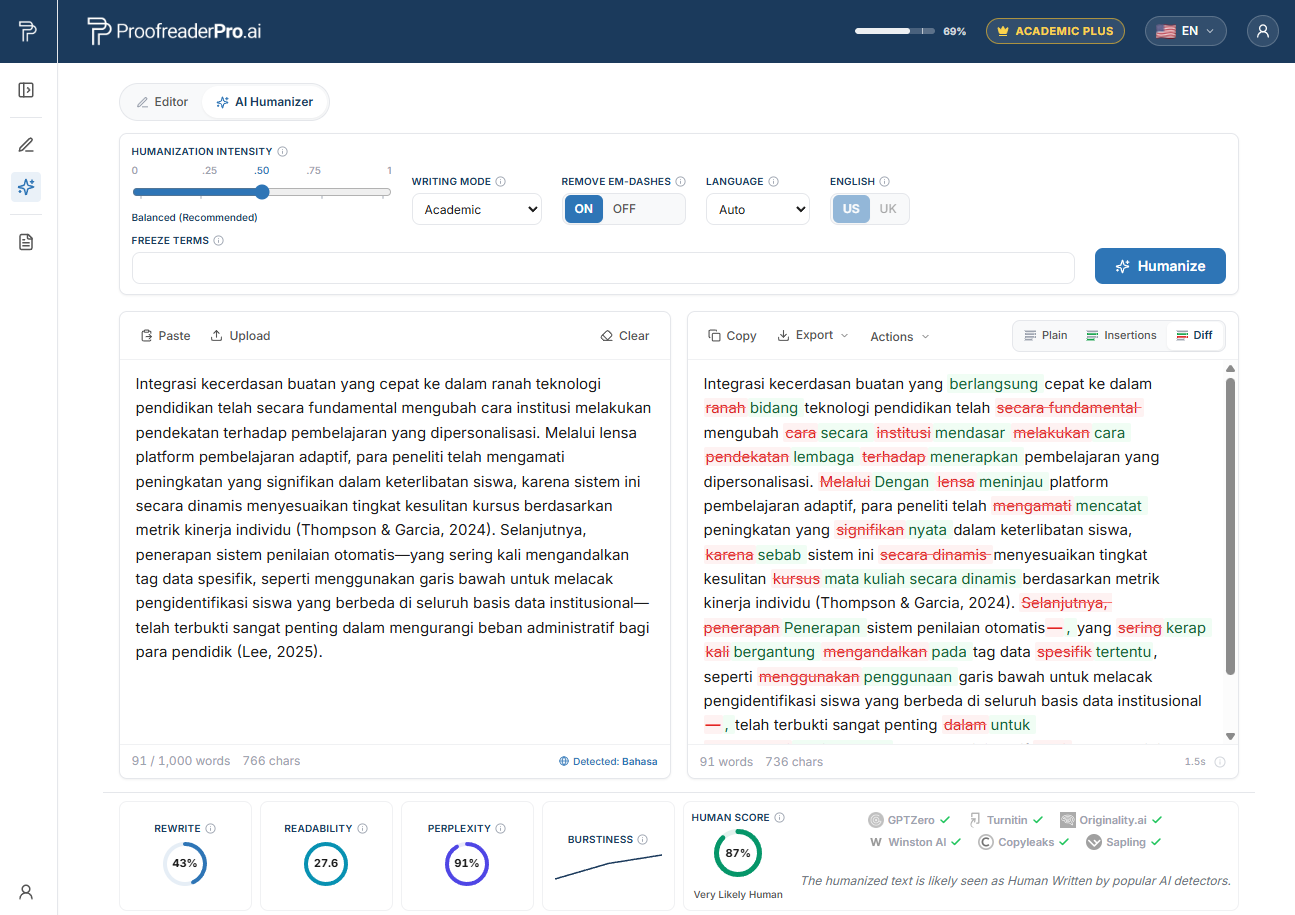
The ProofreaderPro AI Humanizer rewriting Indonesian academic text. The before and after diff keeps your meaning and citations, and the detector checks confirm a natural, human read.
Why Indonesian researchers get flagged by AI detectors
In 2023, a Stanford team led by Weixin Liang published "GPT detectors are biased against non-native English writers" in the Cell Press journal Patterns. The researchers tested seven popular AI detectors on human-written TOEFL essays (all written by real people). About 61% of the non-native essays were identified as AI-generated (on average), compared to about 5% for native English writers. Almost one out of five non-native essays (about 19.8%) was unanimously flagged by all detectors.
The mechanism is perplexity. Many detectors score how surprising each word choice is to a language model. Common words in standard, predictable order produce low perplexity, and low perplexity reads as machine text. Indonesian researchers, writing in a second language, reach for exactly those safe, common, textbook constructions, so their most careful sentences score most like a machine. We explain this trap in detail in why AI detectors flag non-native writers.
The Indonesian first-language patterns behind false flags
Bahasa Indonesia is an Austronesian language with isolating morphology. It carries meaning through word order and context rather than through inflection. Several of its features leave a predictable, standardized trace in academic English. Each pattern below is correct and careful. The problem is that its very regularity looks low-perplexity to a detector.
No tense system. Indonesian marks time with adverbs like sudah, sedang, and akan, and the verb never changes form. Writing English, Indonesian researchers select one clean, consistent tense per section, often the flat simple present of a methods paragraph. That evenness is exactly the smooth, low-variation signal detectors associate with generated text.
No articles. There is no "the," "a," or "an" in Bahasa Indonesia. Careful writers learn the rules and apply them uniformly, and uniform, rule-book article use across a whole manuscript reads as machine-consistent rather than human-varied.
Preposition mapping. One Indonesian preposition covers several English ones: "di" spans in, at, and on, "dengan" spans with and by. To stay safe, second-language writers settle on the most standard English preposition and repeat it. Repetition of the expected choice lowers perplexity further.
No verb conjugation. Indonesian verbs do not change for person or number, so writers apply English subject-verb agreement as a memorised rule and keep it strict. Strict, regular agreement is another marker of the predictable prose detectors were trained to flag.
Optional plural marking. Indonesian marks plurals by reduplication (buku-buku) or by context. In English, careful writers add every "-s" mechanically, producing tidy, textbook noun phrases that read as smooth and unsurprising.
No required copula. "Dia guru" means "she is a teacher" with no linking verb. Compensating, Indonesian writers insert copulas in the most standard positions, once again producing the clean, expected sentence shapes a detector scores as artificial.
Notice the pattern. None of these are errors of thinking. They are the disciplined, standard choices of someone writing precisely in a second language, and standardness is exactly what a perplexity model punishes.
Humanize your own AI-assisted Indonesian research draft
Keep your meaning, technical terms, and citations. Restore natural rhythm to careful second-language English, then disclose your AI use the way your journal requires.
Try the Humanizer FreeIndonesia's AI-detection and Turnitin context
Theses and journal submissions in Indonesia are commonly screened with Turnitin or iThenticate, both for similarity and, increasingly, for AI indicators. Most Indonesian universities run these checks as a routine gate before a defence or a submission, and funders and international journals increasingly ask authors to disclose any AI assistance.
It helps to know how contested these AI scores are. Turnitin itself suppresses AI indicator scores in the 1 to 19% range, showing an asterisk rather than a number, and warns that its score should not drive an integrity decision on its own. In 2023 Vanderbilt disabled Turnitin's AI detector entirely, citing false positives and bias against non-native writers, and Michigan State, UT Austin, Northwestern, Pittsburgh, SMU, and Waterloo took similar steps. Treat any AI flag as a claim you can contest, not a verdict, especially when your work is careful, cited, and your own.
Top Indonesian universities and where AI checks appear
Indonesia has 26 universities in the QS World University Rankings, and its research output is concentrated in a network of public and private institutions across Java and the outer islands. These are the campuses where similarity and AI screening most often decide whether a thesis or manuscript moves forward:
- Universitas Indonesia (UI), Depok and Jakarta
- Universitas Gadjah Mada (UGM), Yogyakarta
- Institut Teknologi Bandung (ITB), Bandung
- Universitas Airlangga (Unair), Surabaya
- Institut Pertanian Bogor (IPB University), Bogor
- Institut Teknologi Sepuluh Nopember (ITS), Surabaya
- Universitas Padjadjaran (Unpad), Bandung
- Universitas Diponegoro (Undip), Semarang
- Universitas Brawijaya (UB), Malang
- Universitas Hasanuddin (Unhas), Makassar
- Universitas Sebelas Maret (UNS), Surakarta
- BINUS University, Jakarta
- Telkom University (Tel-U), Bandung
Across all of them the mandate is the same: publish in Scopus-indexed international journals or watch your career progression stall. That pressure is why so many Indonesian lecturers reach for AI writing help, and why they then need a fair, right way to keep their real work from being misread.
How the AI humanizer for Indonesian researchers works
The workflow has four steps, and it starts with your own draft. First, write, optionally in Bahasa Indonesia and then translated into English so your argument is fully your own. Second, proofread the grammar so tense, articles, prepositions, and agreement are correct. Third, run your AI-assisted prose through our text humanizer, which varies rhythm and word choice, breaks up the flat, repetitive cadence of careful second-language writing, and quietly removes stray em dashes, all while preserving your meaning, technical terminology, and citations. Fourth, disclose your AI use in the format your institution and journal require.
Our humanizer has been tested against the major detectors, and it rewrites AI text into a more natural human form that reads as human across Turnitin, Originality.ai, and GPTZero. The grammar accuracy is over 96% on academic text. This isn't a guarantee but testing results. Detectors retrain every few months, so we never promise to make text "100% undetectable" or to bypass a checker. But what the tool does reliably is give careful non-native prose the natural variation it was missing.
Because the humanizer is language-aware and supports more than 60 languages, it holds sentence structure and meaning steady even on Indonesian-influenced English. If your paper still needs grammar work rather than de-flattening, pair it with our academic editing for researchers in Indonesia. And if you publish across several languages, our multilingual AI humanizer hub collects the country guides in one place.
Local funding bodies, journals, and AI-disclosure expectations
Indonesia's research funding runs through a handful of national systems, and each of them cares about published, English-language output. LPDP (Lembaga Pengelola Dana Pendidikan), the education endowment fund, backs doctoral study at home and abroad and expects its scholars to produce Scopus-indexed publications. The SINTA (Science and Technology Index) platform ranks journals and researchers and shapes what counts for promotion, where a Scopus SJR of 0.15 or above is the bar for full professor. Serdos (Sertifikasi Dosen) ties a lecturer's certification and allowance to sustained publication, and the Ministry of Education, Culture, Research and Technology (Kemendikbudristek) folds international publication counts into every rector's key performance indicators.
The journals themselves increasingly expect an AI-use statement alongside your manuscript. Indonesia now runs a growing set of English-language titles, including the Indonesian Journal of Science and Technology (UPI Bandung), Makara Journal of Science (Universitas Indonesia), the ITB Journal of Science, Jurnal Ilmu Ternak dan Veteriner, Biodiversitas (UNS Surakarta), and the Indonesian Journal of Chemistry (UGM). The safe posture with all of them is consistent: humanize only your own AI-assisted draft, keep every citation intact, and disclose that you used AI. That combination keeps you inside the integrity rules while protecting careful writing from a false flag.
Frequently asked questions
Q: Is an AI humanizer for Indonesian researchers a way to cheat Turnitin?
No. The proper use is to humanize your own AI-assisted draft, not to disguise fabricated or borrowed work. The tool restores natural variation to careful second-language English so it is judged on its ideas, and you still disclose your AI use to your institution and journal.
Q: Will a humanizer AI change my citations or technical terms?
No. Our humanizer is built to preserve meaning, technical terminology, and every citation while it varies rhythm and word choice. It changes how sentences flow, not what they claim or whom they credit.
Q: Can Indonesian researchers really be flagged for writing they did themselves?
Yes, and the evidence is clear. A 2023 Stanford study found that about 61% of human-written non-native essays were flagged as AI, against about 5% for native writers, because careful, predictable second-language prose scores as low-perplexity machine text. That is a fairness problem, not proof of misconduct.
Q: Do I still need to disclose AI use after humanizing my draft?
Yes. Humanizing and disclosing are separate steps that work together. Humanizing protects careful writing from false flags, and disclosure keeps you compliant with the rules at your university and your target journal.
Q: Does the humanizer work if I draft in Bahasa Indonesia first?
Yes. Because the tool is language-aware and supports more than 60 languages, you can draft in Bahasa Indonesia, translate, proofread, and then humanize the English while sentence structure and meaning stay intact. Many LPDP scholars find this pipeline faster than writing directly in English.
Humanize your own AI-assisted draft. Preserve meaning and citations, reduce false AI flags on careful non-native English, then disclose your AI use.

Moe is an NLP engineer with a PhD in natural language processing. His research covers computational linguistics, text analysis, and machine learning, and it fed directly into the editing and humanization models behind ProofreaderPro. He writes about the part of the process most people never see: how a language model reads a sentence, scores it, and decides what to change.