AI Humanizer for Hungarian Researchers Writing in English
AI humanizer for Hungarian researchers. Reduce false AI-detection flags on Hungarian-influenced English, keep meaning and citations, disclose honestly.

Hungarian science punches above its weight. A country of fewer than ten million people has produced a remarkable line of mathematicians, physicists, chemists, and life scientists, and that tradition still shows up in the output of its universities today. The work gets written in English, though. Almost every researcher in Budapest or Szeged drafts and thinks in Hungarian first, then carries the argument across into a second language that shares almost none of its grammar. That translation gap is exactly where an AI humanizer for Hungarian researchers earns its place, because careful Hungarian-English is now being misread as machine text.
Here is the uncomfortable part. The cleaner and more standard your English, the more likely an AI detector is to flag it. A model that scores text by how "surprising" each word is treats your disciplined, predictable phrasing as a signal of machine authorship. Your reward for writing clearly in a hard second language is a false accusation.
We built our humanizer for that specific problem: to protect real work by real researchers, not to hide anyone's shortcuts. This guide explains how it fits into an honest publishing workflow for scholars in Hungary.
AI-szöveg humanizálása magyar kutatóknak
Az AI-szöveg humanizálása azt jelenti, hogy a saját, mesterséges intelligenciával segített szövegét emberibb ritmusúvá teszi, miközben a jelentés, a szakkifejezések és a hivatkozások változatlanok maradnak. Our tool is built for Hungarian academics who draft in their own language and then publish in English.
The point is not to disguise anything. The point is that a careful, standard English sentence written by a Hungarian scholar should not be treated as suspect simply because it is careful and standard. That is the false flag our text humanizer is designed to reduce.
Drafting in Hungarian? The humanizer detects and rewrites it directly
You can humanize a Hungarian draft without translating it into English first. Paste your text and ProofreaderPro detects the language automatically, then routes it through a Hungarian-aware model that respects the long vowels, agglutinated forms, and citations in your writing. As AI-szöveg humanizálása it varies the rhythm of your Hungarian prose while keeping every term and reference intact. Automatic detection reaches across more than sixty languages, so Hungarian is treated as Hungarian rather than reshaped into English.
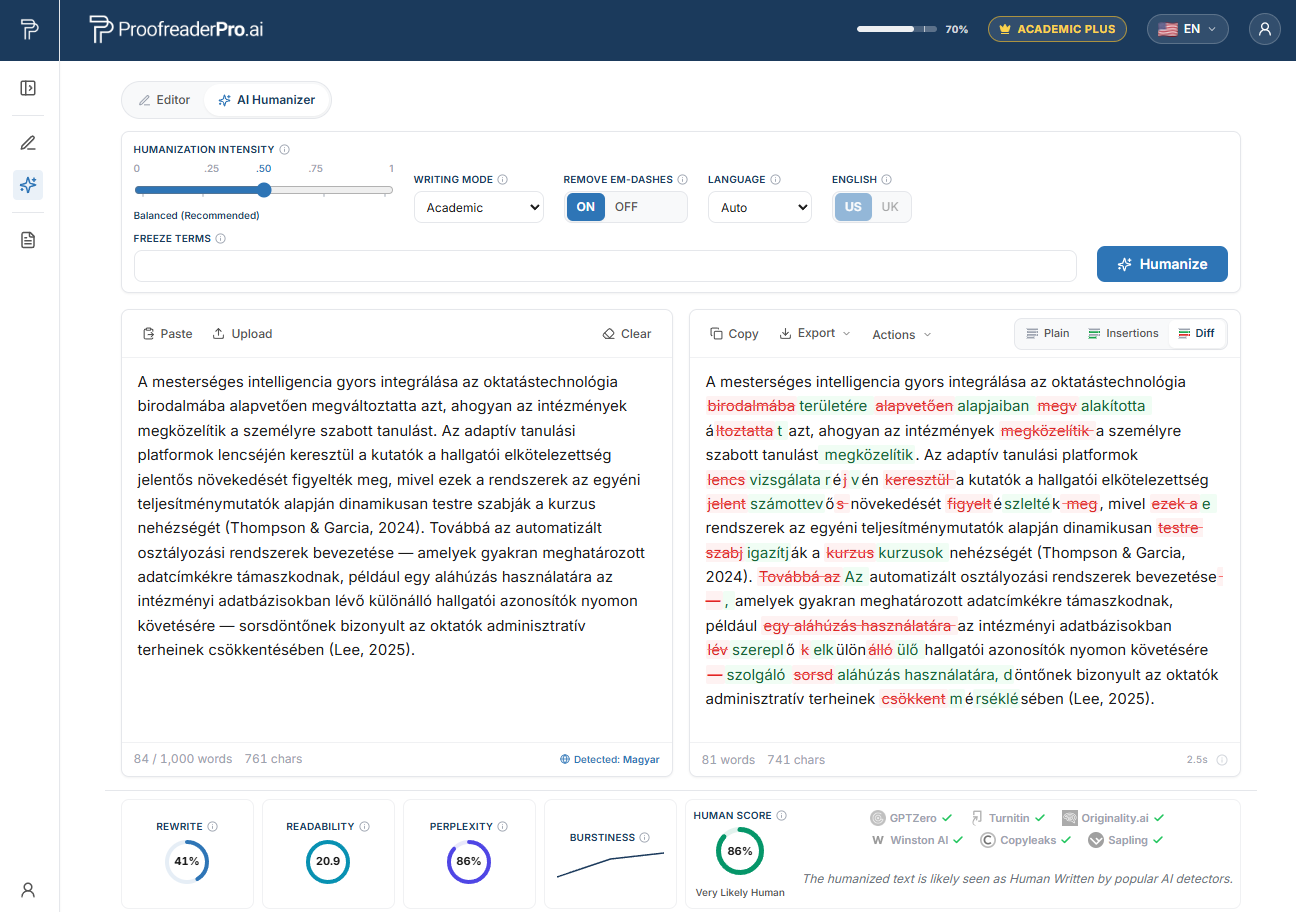
The ProofreaderPro AI Humanizer rewriting Hungarian academic text. The before and after diff keeps your meaning and citations, and the detector checks confirm a natural, human read.
Why Hungarian researchers get flagged by AI detectors
In 2023, a Stanford research group led by Weixin Liang tested seven widely used GPT detectors on essays written by humans. The essays came from the TOEFL exam, so every one of them had a human author who happened to be a non-native English writer. On average, about 61% of those essays were flagged as AI-generated. For essays by native English speakers, the figure was about 5%. Nearly one in five of the non-native essays, roughly 19.8%, was flagged unanimously by every single detector.
Read that again. Human writing, flagged more than ten times as often, purely because English was the author's second language.
The mechanism is called perplexity. Many detectors estimate how predictable your word choices are to a language model. When you write in a second language, you reach for the safe, common, correct construction, because that is what careful writers do. Safe and common means low perplexity, and low perplexity is precisely the fingerprint these tools were trained to read as machine text. We unpack the full mechanism in why AI detectors flag non-native writers, but the short version is brutal: the habits that make your prose clear are the habits that get it flagged.
The Hungarian first-language patterns behind false flags
Hungarian is a Uralic language, unrelated to the Indo-European languages surrounding it, and its logic is genuinely different from English. That difference leaves fingerprints in Hungarian-English writing. None of these fingerprints are errors of intelligence. They are the shadow of a very different grammar, and once smoothed into clean English, they read as flat and predictable to a detector.
One pronoun for he and she. Hungarian has a single third-person pronoun and no grammatical gender, so "he" and "she" get swapped in English. Writers who correct for this tend to overuse the safest option or rebuild sentences around "the author" and "the participant," which produces very even, low-variation prose.
Articles distributed differently. Hungarian does use articles (a, az, egy), but places them on a different logic than English. Definite and indefinite articles get dropped or added, and the careful fix is usually the most standard, textbook article each time. Standard is exactly what scores as machine-like.
Agglutination and heavy nominalisation. Hungarian builds meaning by stacking suffixes onto a stem. Transferred into English, that habit turns into dense noun phrases and long nominalised chains ("the implementation of the optimisation of...") that are grammatically perfect and rhythmically monotonous. Detectors love monotony.
Topic-prominent word order. Hungarian foregrounds the topic and the focus of a sentence, so the emphasis lands in a different place than an English reader expects. When a writer normalises this into plain subject-verb-object English, the result is correct, orderly, and predictable.
No future tense marker and a different aspect system. Hungarian marks the future differently and handles aspect its own way, so English tense choices come out inconsistent, then get corrected toward the most neutral, common tense. The safest tense is again the lowest-perplexity one.
Postpositions instead of prepositions. Hungarian puts its relational markers after the noun, which produces preposition slips in English. Fixing those slips means reaching for the standard preposition every time, and standard is what a detector reads as generated.
Protect your careful Hungarian-English from false flags
Humanize your own AI-assisted draft while keeping every citation, term, and finding intact, then disclose your tools with confidence.
Try the Humanizer FreeHungary's AI-detection and Turnitin context
Theses and journal submissions from Hungarian institutions are routinely screened for text similarity, most often with Turnitin or a comparable system, and AI indicators are increasingly folded into that same screening. This is now a normal part of doctoral defence and manuscript review, not an exceptional step.
It is worth keeping the limits of these tools in view. Several major universities abroad, including Vanderbilt, have switched off Turnitin's AI-writing detector over false positives and bias against non-native writers, and Turnitin itself suppresses its lowest scores and warns that its number should never decide an integrity case on its own. A detector score is a claim you are allowed to contest, not a verdict.
Hungarian institutions have issued their own guidance on generative AI, and funders and journals increasingly expect authors to disclose how these tools were used. The honest response is not to hide anything. It is to write and edit responsibly, then declare the tools you relied on.
Top Hungarian universities and where AI checks appear
Screening for similarity and AI indicators shows up across the Hungarian higher-education system, from doctoral schools to journal editorial offices. The following institutions are among the most research-intensive in the country, and their theses and manuscripts pass through these checks:
- Eötvös Loránd Tudományegyetem (Eötvös Loránd University, ELTE), Budapest
- Semmelweis Egyetem (Semmelweis University), Budapest, a major medical school
- Szegedi Tudományegyetem (University of Szeged), Szeged
- Debreceni Egyetem (University of Debrecen), Debrecen
- Budapesti Műszaki és Gazdaságtudományi Egyetem (Budapest University of Technology and Economics, BME), Budapest
- Budapesti Corvinus Egyetem (Corvinus University of Budapest), Budapest
- Pécsi Tudományegyetem (University of Pécs), Pécs
- Pázmány Péter Katolikus Egyetem (Pázmány Péter Catholic University), Budapest
- Óbudai Egyetem (Óbuda University), Budapest
Whether your work is a dissertation defended at ELTE or a clinical manuscript from Semmelweis, the same dynamic applies: standard, careful Hungarian-English is the writing most likely to trip a perplexity-based flag.
How the AI humanizer for Hungarian researchers works
The workflow we recommend is simple and, more importantly, honest. It has three stages.
First, draft. Write your paper the way that gets your thinking onto the page fastest. For many Hungarian researchers that means drafting in Hungarian and translating, or writing directly in English with AI assistance. Either is fine.
Second, proofread the substance. Fix the grammar, the terminology, and the argument so the science is correct. If the language itself needs a careful pass, our global academic editing hub covers that side of the work.
Third, humanize your own draft. This is where the text humanizer comes in. It varies sentence length and rhythm, breaks up the monotone cadence that agglutinative Hungarian-English tends to produce, and removes the stray em dashes and repetitive structures that both AI tools and second-language habits leave behind. Crucially, it preserves your meaning, your technical vocabulary, and every citation. Non-English source text routes through a language-aware model, and the tool supports more than sixty languages.
What does that achieve? In our own testing, humanizing a careful non-native draft substantially reduces how often the major detectors misread it as machine-written, while leaving the academic meaning intact. We describe that as what we have seen in testing, not as a promise. No honest tool can guarantee a result here, because detectors retrain every few months, and any service claiming to be 100% undetectable is selling you something it cannot deliver.
Then, the last step: disclose. Add an AI-use statement in the format your university and target journal require. Humanizing your own AI-assisted writing and then declaring it is not a trick. It is you making sure your careful work is judged on its merits instead of being flagged for the crime of being clear in a second language. For the wider language picture across countries, see our multilingual AI humanizer hub.
Local funding bodies, journals, and AI-disclosure expectations
Competitive research in Hungary is funded largely through NKFIH (Nemzeti Kutatási, Fejlesztési és Innovációs Hivatal, the National Research, Development and Innovation Office), with the MTA (Magyar Tudományos Akadémia, the Hungarian Academy of Sciences) as the national academy and HUN-REN (the Hungarian Research Network) running the public research institutes. All of them reward published, indexed output, which keeps steady pressure on researchers to publish in English.
That output is measured in Web of Science and Scopus-indexed journals and registered in the MTMT (Magyar Tudományos Művek Tára, the Hungarian Scientific Bibliography), the national publication database. The evaluation culture rewards international, English-language publishing, which is exactly the pressure that pushes Hungarian scholars toward the clean, standard prose that detectors misread.
Expect AI-use disclosure to become more common in both grant reporting and journal submission. Treat it as routine. Say plainly which tools you used and how, keep your data and citations honest, and you stay comfortably inside the rules while defending your writing against unfair flags.
Frequently asked questions
Q: Does the AI humanizer for Hungarian researchers change my citations or technical terms?
No. The humanizer is built to preserve your meaning, your discipline-specific terminology, and every reference exactly as you wrote them. It changes rhythm and phrasing, not your science or your sources.
Q: Can any tool guarantee my paper will pass every AI detector?
No, and you should distrust anyone who claims otherwise. Detectors are retrained regularly, so no honest service can promise to be 100% undetectable. What we can say is that, in our testing, humanizing careful non-native prose substantially reduces how often it is misread as machine-written.
Q: Is humanizing my own draft a form of cheating?
It is not, as long as you are working on your own AI-assisted writing, keeping your findings honest, and disclosing your tool use as your institution and journal require. The goal is fairness for genuine work, not disguise.
Q: Why does my clear English get flagged when weaker writing does not?
Because many detectors score predictability. Careful second-language writers reach for safe, standard, correct constructions, which produces low-perplexity text, and low perplexity is the exact pattern these tools associate with machine writing. Your clarity works against you.
Q: I write in Hungarian first. Does the tool handle that?
Yes. Non-English text routes through a language-aware model that preserves sentence structure and meaning across more than sixty languages, so you can draft in Hungarian, translate, and then humanize the English version without losing your argument.
Turn your careful, AI-assisted Hungarian-English draft into natural academic prose that keeps every citation and finding, then disclose your AI use with confidence.

Moe is an NLP engineer with a PhD in natural language processing. His research covers computational linguistics, text analysis, and machine learning, and it fed directly into the editing and humanization models behind ProofreaderPro. He writes about the part of the process most people never see: how a language model reads a sentence, scores it, and decides what to change.