AI Humanizer for Greek Researchers Writing in English
AI humanizer for Greek researchers. Reduce false AI-detection flags on Greek-influenced English, keep meaning and citations, disclose honestly.

A physicist at the National Technical University of Athens drafts her methods section in English, checks every article and every tense twice, then submits to a Scopus-indexed journal. Weeks later a co-author forwards an editor's note: an automated AI detector flagged part of the manuscript as machine-written. She wrote every sentence herself.
That scenario is common enough now that it shapes how careful researchers feel about submitting at all. An AI humanizer for Greek researchers exists to address it, and the reason it is needed says more about the detectors than about the writing.
Greek research is strong in engineering, computer science, physics, medicine, and the classics, and much of it reaches the world in English while the thinking and first drafts happen in Greek. Progression and unit evaluation reward publications in Web of Science and Scopus, so the pressure to publish in clear English never lets up. The catch is that clear, standard second-language English is exactly the kind of writing these tools most often misread.
Humanising AI text for Greek researchers (εξανθρωπισμός κειμένου AI)
Our humanizer helps Greek academics publish in English without having careful, native-influenced prose mistaken for a machine. It works on your own AI-assisted draft, keeps your meaning and citations intact, and varies the rhythm and word choice that detectors fixate on. You can test it on the text humanizer with any paragraph that has been unfairly flagged.
This guide is one node in a wider multilingual AI humanizer hub that covers the same problem across more than sixty languages, because the false-flag pattern repeats wherever people write academic English as a second language.
Drafting in Greek? The humanizer detects and processes it too
Not every draft begins in English, and the humanizer does not require it to. Paste Greek text and ProofreaderPro recognises the Greek alphabet automatically, then routes it through a language-aware model that keeps your terminology, accents, and citations exactly as written. As εξανθρωπισμός κειμένου AI it rewrites your Greek prose directly, so you can humanize before you translate. The same detection covers more than sixty languages, each rewritten as itself.
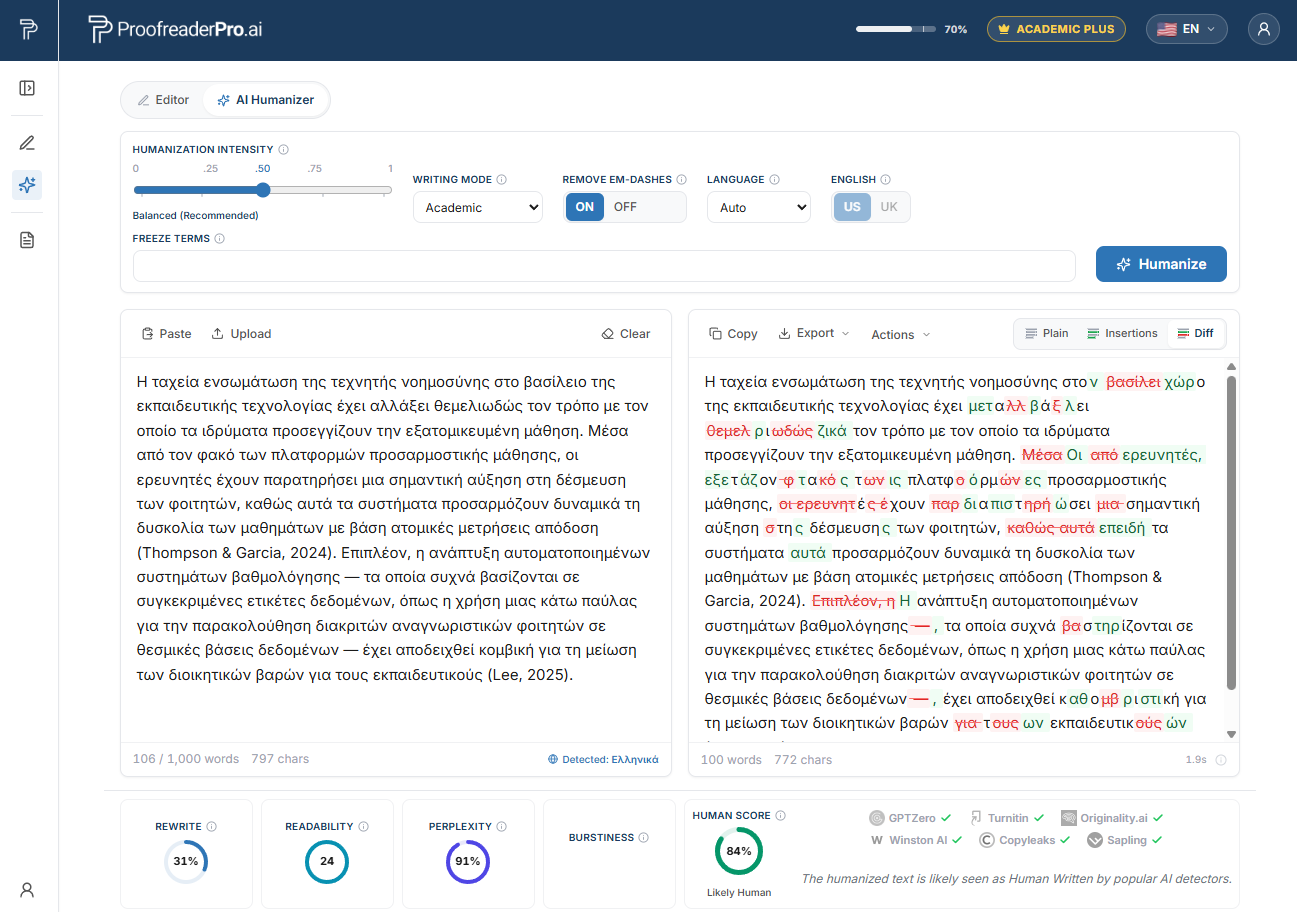
The ProofreaderPro AI Humanizer rewriting Greek academic text. The before and after diff keeps your meaning and citations, and the detector checks confirm a natural, human read.
Why Greek researchers get flagged by AI detectors
Start with the study that put numbers on the problem. In 2023 a Stanford team led by Weixin Liang published "GPT detectors are biased against non-native English writers" in the Cell Press journal Patterns. They took human-written TOEFL essays and ran them through seven widely used detectors.
The result was lopsided. On average about 61% of the essays by non-native writers were flagged as AI, against roughly 5% for native English writers. Nearly one in five non-native essays, about 19.8%, was flagged unanimously by every detector in the set. Every one of those essays had a human author.
The mechanism is called perplexity. Many detectors score how surprising each next word is to a language model, and text built from common words in predictable order scores low. Low perplexity reads as machine text. A careful Greek researcher who chooses standard vocabulary and safe sentence patterns is producing precisely the prose the detector was trained to distrust. We go deeper into this failure mode in why AI detectors flag non-native writers.
The Greek first-language patterns behind false flags
None of the habits below are errors. They are correct, standard constructions, and that is exactly why they lower perplexity and draw a flag.
Articles are the clearest case. Greek uses the definite article with abstract nouns, proper names, and generics, so English written by a Greek speaker fills naturally with "the": "the science shows", "the Professor Papadopoulos argued", "the nature of the problem". Each phrase is grammatical, and the steady accumulation of them is very regular.
Tense and aspect give a second signal. Greek marks aspect in ways English does not, so the choice between the present perfect and the simple past, or between simple and continuous forms, can come out evenly and predictably across a paragraph. A detector reads that evenness as a pattern rather than as a person making choices.
Sentence length matters too. Greek academic style favours long periods bound together with heavy connectives, so "moreover", "furthermore", and "in addition" stack up at the seams of an argument. Those connectives are also among the highest-probability words a model expects to see next, which pulls perplexity down even further.
Two more transfer effects round it out. Word order carries over from a language with freer word order, producing topicalised sentences that are correct but uniform in shape. And transliteration choices, when names and technical terms move out of the Greek alphabet, add their own layer of regularity. Put together, these traits make honest Greek-English look, to a detector, suspiciously smooth.
Greece's AI-detection and Turnitin context
Theses and journal submissions from Greek institutions are routinely screened. Similarity checking with Turnitin or iThenticate is standard practice for dissertations and manuscripts, and the same platforms now surface AI-writing indicators alongside the similarity score.
Universities across Greece have issued their own generative-AI guidance, and the direction of travel points toward disclosure rather than prohibition. Funders and journals increasingly ask authors to state where and how AI tools were used. None of this makes AI assistance forbidden. It makes honesty about it the expectation, which is a very different thing from hiding it.
A detector score, it is worth remembering, is not a verdict. Turnitin itself suppresses low AI scores and warns that its number should not be the sole basis for an integrity decision. Several universities elsewhere have gone further and switched their AI detectors off over exactly the bias documented above. A flag is a claim you are allowed to contest, not a finding of guilt.
Stop letting a biased detector speak for your research
Paste a flagged paragraph and see how humanizing preserves your meaning, terminology, and citations while varying the rhythm detectors misread.
Try the Humanizer FreeTop Greek universities and where AI checks appear
The institutions below screen theses and manuscripts for similarity and increasingly weigh AI indicators. If you write at any of them, expect your dissertation or submission to pass through one of these systems.
- Εθνικό και Καποδιστριακό Πανεπιστήμιο Αθηνών (National and Kapodistrian University of Athens, NKUA), in Athens
- Αριστοτέλειο Πανεπιστήμιο Θεσσαλονίκης (Aristotle University of Thessaloniki, AUTH), in Thessaloniki
- Εθνικό Μετσόβιο Πολυτεχνείο (National Technical University of Athens, NTUA), in Athens
- Πανεπιστήμιο Πατρών (University of Patras), in Patras
- Πανεπιστήμιο Κρήτης (University of Crete), in Heraklion and Rethymno
- Πανεπιστήμιο Ιωαννίνων (University of Ioannina), in Ioannina
- Πανεπιστήμιο Θεσσαλίας (University of Thessaly), in Volos
- Οικονομικό Πανεπιστήμιο Αθηνών (Athens University of Economics and Business, AUEB), in Athens
- Δημοκρίτειο Πανεπιστήμιο Θράκης (Democritus University of Thrace), in Komotini
The list is not the whole of Greek higher education, but it covers where most English-language research writing, and most screening, actually happens.
How the AI humanizer for Greek researchers works
The workflow is honest and plain, and it keeps you inside the rules.
Draft first. Write in Greek if that is where your thinking is clearest and then translate, or draft directly in English with whatever assistance you use. Get the argument and the evidence right before you worry about how it reads.
Proofread the grammar next. Fix the article overuse, settle the tenses, and check terminology so the meaning is exactly what you intend. Our text humanizer is not a substitute for this step, because clean input produces better output.
Then humanize your own AI-assisted prose. The tool varies sentence rhythm and word choice, breaks up the uniform cadence that reads as low perplexity, and clears the tell-tale traces such as repeated connectives and stray em dashes, all while preserving your meaning, your technical terminology, and every citation. Non-English text routes through a language-aware model, so a Greek passage keeps its structure instead of being flattened.
What can we honestly claim about results? In our own testing, humanizing substantially reduces how often careful, standard non-native English is misread by the major detectors such as Turnitin, Originality.ai, and GPTZero, while keeping the academic sense intact. We will not put a number on it. Detectors retrain every few months, and no honest tool can promise to be 100% undetectable. Anyone who guarantees that is selling you something.
Finally, disclose. State your AI use in the format your supervisor, your institution, and your target journal require. Humanizing protects careful writing from a biased flag; disclosure keeps you honest about the assistance you used. The two belong together. For editing help that goes beyond humanizing, our global academic editing hub collects the language-support resources in one place.
Local funding bodies, journals, and AI-disclosure expectations
Competitive research money in Greece runs largely through HFRI, the Hellenic Foundation for Research and Innovation (ΕΛΙΔΕΚ), which funds investigator-led projects, while GSRI, the General Secretariat for Research and Innovation, sets national research policy. Many Greek groups also hold European Research Council (ERC) grants. Each of these has its own reporting culture, and AI-use disclosure is steadily becoming part of it.
On the publishing side, Greek researchers aim for Web of Science and Scopus-indexed journals, and the National Documentation Centre (EKT) maintains the national repositories and research statistics. Most international journals now carry an AI-disclosure clause in their author guidelines. The safe habit is to read that clause before you submit and to write a short statement describing your tools, rather than leaving your process to be inferred.
Keep the reasoning in view. Humanizing your own draft is not a way around any of this. It protects clear Greek-English from a documented detector bias, and disclosure keeps the record straight. Real work, treated fairly.
Frequently asked questions
Q: Will an AI humanizer help if my paper was flagged even though I wrote it myself?
Yes, that is the exact case it is built for. Careful non-native English scores low on perplexity and gets misread as machine text, and humanizing varies the rhythm and word choice that trigger the flag while keeping your meaning. It cannot erase the fact that detectors are imperfect, but it removes the specific traits they overweight.
Q: Does humanising AI text change my citations or technical terms?
No. The humanizer preserves citations, references, and domain terminology, because altering them would damage the paper. It works on cadence and phrasing, not on your evidence or your specialist vocabulary.
Q: Is using an AI humanizer for Greek researchers considered cheating?
Not when you use it honestly. You humanize your own AI-assisted draft, keep your meaning and citations, and then disclose your AI use the way your institution and journal require. The goal is fairness for real writing, not disguise of fabricated work.
Q: Can any tool guarantee my text will pass every AI detector?
No, and you should distrust anyone who says so. Detectors change their models regularly, so no tool can promise to be 100% undetectable. What a good humanizer can do is reduce how often honest non-native prose is misflagged, which is what we see in testing.
Q: I drafted in Greek and then translated. Does that make a flag more likely?
It can, because translated academic prose tends to be very standard and regular, and that is precisely what reads as low perplexity. Humanizing the translated draft, and then disclosing your process, is a sensible way to keep clear writing from being penalised for its clarity.
Built for non-native academics: reduce false AI flags on careful Greek-English while preserving citations, terminology, and argument.

Moe is an NLP engineer with a PhD in natural language processing. His research covers computational linguistics, text analysis, and machine learning, and it fed directly into the editing and humanization models behind ProofreaderPro. He writes about the part of the process most people never see: how a language model reads a sentence, scores it, and decides what to change.