AI Humanizer for Czech Researchers Writing in English
AI humanizer for Czech researchers. Reduce false AI-detection flags on Czech-influenced English, keep meaning and citations, disclose honestly.

Czechia publishes above its weight. A small country with a large research base, it holds real international standing in physics, chemistry, materials science, and the life sciences, much of it anchored by the Czech Academy of Sciences. Almost all of that work reaches the world in English, even though most of it is thought through and first drafted in Czech.
That gap between the language you reason in and the language you publish in is exactly where the trouble begins. An AI humanizer for Czech researchers exists for a blunt reason: careful, correct English written by a Czech scientist is now being misread as machine text by automated detectors, and a single false flag on a clean paper can cost you a submission, a grade, or a reputation you spent years building.
Here is the uncomfortable part. The habits that make Czech-English clear enough to publish, standard phrasing, common vocabulary, predictable sentence shapes, are the very habits an AI detector was trained to treat as suspicious.
Humanizace AI textu pro české výzkumníky publikující v angličtině
Naše humanizace AI textu pomáhá českým výzkumníkům publikovat v angličtině, aniž by jejich pečlivě napsaná práce byla nespravedlivě označena detektory jako strojově psaná. Cílem je zachovat význam, odbornou terminologii i citace.
In plain terms: our tool works on the English you have already written or drafted with AI help, keeps your argument and your references intact, and reshapes the rhythm so a detector is less likely to misjudge it. It is built for real research, not for disguising work you did not do. You can try it on our humanizer with a paragraph of your own before you trust it with a whole manuscript.
Writing in Czech? It is auto-detected and humanized directly
Czech researchers often draft in their first language before moving into English, and the humanizer is built for that. Paste Czech text and ProofreaderPro detects the language on its own, then processes it through a Czech-aware model that keeps the háček and other diacritics, your terminology, and your citations exactly in place. Through humanizace AI textu your Czech draft is humanized as readily as your English, with nothing translated first. The same detection spans more than sixty languages, each rewritten in its own voice.
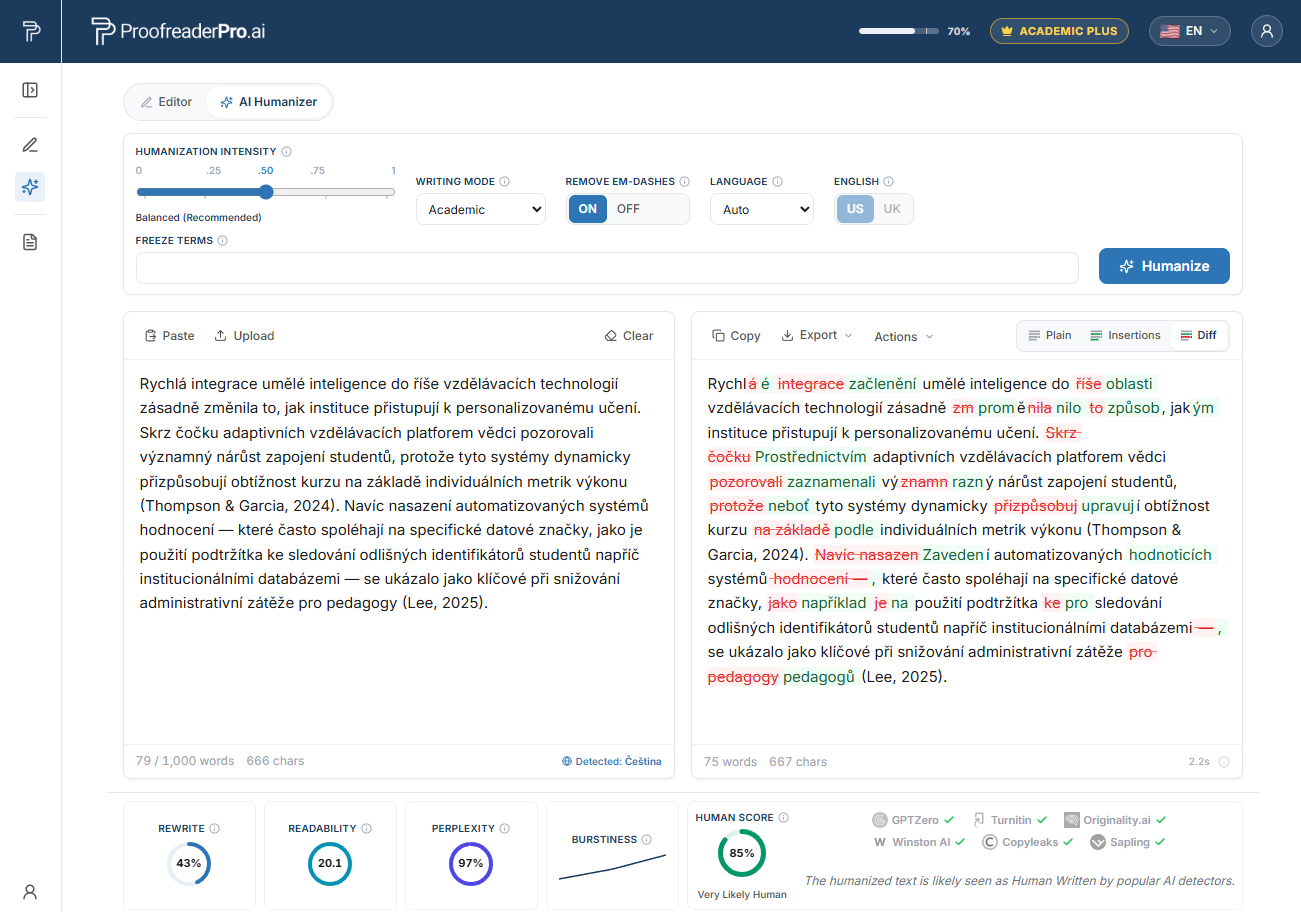
The ProofreaderPro AI Humanizer rewriting Czech academic text. The before and after diff keeps your meaning and citations, and the detector checks confirm a natural, human read.
Why Czech researchers get flagged by AI detectors
In 2023, a team at Stanford led by Weixin Liang published a study in the Cell Press journal Patterns with a title that says it all: "GPT detectors are biased against non-native English writers." The researchers took TOEFL essays written entirely by humans and ran them through seven widely used AI detectors.
The result should worry anyone who writes English as a second language. On average, about 61% of the non-native essays were flagged as AI-generated, compared with roughly 5% of essays by native English speakers. Nearly one in five non-native essays, about 19.8%, was flagged unanimously by every single detector. Not one of these texts was written by a machine.
The mechanism is called perplexity. Many detectors score how surprising each word choice is to a language model. A confident native writer takes risks, uses idioms, and varies phrasing in ways a model finds unpredictable, which reads as human. A careful Czech researcher does the opposite: chooses the safe word, the standard construction, the sentence shape drilled into every English course. That caution produces low perplexity, and low perplexity is what a detector reads as machine text. We explain the full mechanism in why AI detectors flag non-native writers.
The Czech first-language patterns behind false flags
Czech and English are built on different grammar, and the places where they disagree leave fingerprints in your English. None of these are errors of thought. They are the predictable, standard traces of a Czech mind writing careful English, and their very regularity is what a detector scores as low perplexity.
Articles that appear and vanish. Czech has no "the" or "a". English articles get dropped, added, or swapped, so you write "result was significant" or "we performed the analysis of the data". Once an editor tidies these, the surrounding sentences often become even more textbook-standard, which raises the flag risk rather than lowering it.
Aspect standing in for tense. Czech grammar turns on perfective and imperfective aspect rather than the English tense system. The perfect versus the simple past comes out inconsistent, and the corrected version tends to snap toward the most conventional tense choice a model expects.
Word order that carries emphasis. Czech leans on case endings for meaning and on word order for stress, so English information structure can transfer awkwardly. Smoothed into standard subject-verb-object English, the sentence loses exactly the unpredictability a detector reads as human.
Countable nouns that go plural. "Informations", "researches", "an advice", "evidences". These are logical in Czech and common in Czech-English drafts, and once fixed the phrasing lands squarely in the register detectors were trained on.
Prepositions and missing auxiliaries. Prepositions transfer straight from Czech, and the auxiliary "do" or "does" goes missing in questions and negatives. Corrected, these constructions become clean and generic, which is precisely the profile that reads as low perplexity.
Czechia's AI-detection and Turnitin context
Theses and journal submissions in Czechia are routinely screened for both similarity and AI-generated text. Many Czech universities share a national infrastructure for this, the Theses.cz and Odevzdej.cz systems coordinated by Masarykova univerzita, and Turnitin is widely used alongside them.
Czech institutions have issued their own guidance on generative AI, and the direction of travel is clear: funders and journals increasingly expect you to disclose how you used AI. That climate is reasonable. The problem is not disclosure, which is easy and honest. The problem is a detector score treated as a verdict, when in reality it is a statistical guess that misfires most often on exactly the careful non-native prose Czech researchers are trained to produce.
It helps to remember that even the detector vendors hedge. Turnitin suppresses its own scores in the low range and warns that a number should never be used alone for an integrity decision. Several universities, including Vanderbilt, went further and switched their AI detector off entirely, citing false positives and bias against non-native writers. A flag is a claim to contest, not a confession.
Protect your Czech-English writing from false AI flags
Paste a paragraph of your own research prose and see how the humanizer preserves your meaning and citations while reducing the chance a detector misreads careful non-native English.
Try the Humanizer FreeTop Czech universities and where AI checks appear
If you study, teach, or submit in Czechia, your work will pass through one of these institutions, and all of them screen theses and manuscripts for similarity and increasingly weigh AI indicators.
- Univerzita Karlova (Charles University), Prague
- České vysoké učení technické v Praze (ČVUT, Czech Technical University), Prague
- Masarykova univerzita (Masaryk University), Brno
- Univerzita Palackého v Olomouci (Palacký University), Olomouc
- Vysoké učení technické v Brně (VUT, Brno University of Technology), Brno
- Vysoká škola chemicko-technologická v Praze (VŠCHT, University of Chemistry and Technology), Prague
- Vysoká škola báňská, Technická univerzita Ostrava (VŠB-TUO), Ostrava
- Mendelova univerzita v Brně (Mendel University), Brno
- Jihočeská univerzita v Českých Budějovicích (University of South Bohemia), České Budějovice
- Univerzita Pardubice, Pardubice
The stakes differ by document. A rejected journal manuscript costs you months. A thesis flagged at Univerzita Karlova or Masarykova univerzita can trigger a hearing that puts your integrity, rather than your grammar, on trial. That is the wrong conversation to have over a false positive.
How the AI humanizer for Czech researchers works
The honest workflow is straightforward, and disclosure sits at the center of it, not at the edges.
Start where you are strongest. Draft in Czech if that is how you think best, then translate, or draft in English directly with AI assistance. Get the science right first. Then fix the grammar so the meaning is precise. Only after that do you run the text through the AI humanizer for Czech researchers, which reshapes rhythm and word choice so your careful, standard English is less likely to be misread by a detector, while your meaning, terminology, and citations stay exactly as you wrote them.
What can you expect? In our own testing, the humanizer substantially reduces how often careful non-native English is misread by the major detectors, including Turnitin, Originality.ai, and GPTZero, without touching your argument. We describe this as what we have seen in testing, not as a promise. Detectors retrain every few months, and no honest tool can promise to be 100% undetectable. Anyone who guarantees that is selling you something.
Non-English text matters here too. Because the humanizer supports more than 60 languages and routes non-English through a language-aware model, you can work on Czech drafts or mixed-language notes without the tool flattening your sentence structure. This spoke sits inside our multilingual AI humanizer hub, and it pairs naturally with hands-on editing from our global academic editing hub when a manuscript needs a human eye as well.
Then comes the step that keeps the whole thing honest: disclose your AI use in the format your institution and target journal require. Humanizing your own draft protects clear writing from an unfair flag. Disclosing your method keeps you inside the rules. You do both, and you have nothing to hide.
Local funding bodies, journals, and AI-disclosure expectations
Czech research funding runs mostly through three bodies, and each one increasingly expects transparency about AI use. GAČR (Grantová agentura České republiky, the Czech Science Foundation) funds basic research. TAČR (Technologická agentura České republiky, the Technology Agency) funds applied research. AV ČR (Akademie věd České republiky, the Czech Academy of Sciences) runs the national institutes where a large share of the country's output originates.
On the publishing side, the pressure points in one direction. National evaluation and institutional budgets reward output in Web of Science and Scopus-indexed journals, and results are reported to the national R&D information register, RIV. That rewards English-language publication, which loops you straight back to the false-flag problem this article started with.
Remember what the numbers already tell us about that barrier. Non-native English speakers face rejection rates about 2.5 times higher than native speakers, spend roughly 51% more time writing their papers and about 91% more time reading them, and receive around 12.5 times more revision requests tied to language quality. Fewer than 7% of journals accept non-English submissions at all. The system asks Czech researchers to compete in English, then penalizes the careful English that competition produces. Humanizing your own draft, keeping your citations, and disclosing your method is a fair response to an unfair setup, not a way around it. Use the humanizer as one tool in that honest workflow.
Frequently asked questions
Q: Does using an AI humanizer for Czech researchers count as cheating?
No, not when you use it honestly. You are reshaping the rhythm of your own AI-assisted draft, keeping your meaning and citations, and then disclosing your AI use the way your institution and journal require. That is language editing plus transparency, not deception. It becomes a problem only if you try to pass off work you did not do or hide a use you were asked to declare.
Q: Will the humanizer change my technical terms or my citations?
No. The tool is built to preserve academic meaning, specialist terminology, and reference markers while it varies sentence rhythm and word choice. Your chemistry stays chemistry and your citations stay in place. You should still proofread the final version, because you remain the author responsible for every word.
Q: Can you guarantee my paper will pass Turnitin or GPTZero?
No, and you should distrust anyone who does. Detectors retrain constantly, so no honest tool can promise to be 100% undetectable. What we can say is that, in our testing, humanizing careful non-native English substantially reduces how often the major detectors misread it, while keeping your meaning intact.
Q: Why does my correct Czech-English get flagged in the first place?
Because careful second-language writing tends to be low in perplexity. You choose safe words and standard constructions, and detectors read that predictability as machine-generated. The Stanford study found human-written non-native essays flagged as AI far more often than native ones, which shows the bias sits in the detector, not in your writing.
Q: Do I still have to tell my university or journal that I used AI?
Yes, whenever they ask, and increasingly they do. Humanizing your draft is about fairness, not concealment, so disclosure is the point rather than the loophole. State clearly how you used AI in your drafting and editing, and you stay on the right side of both integrity rules and your own conscience.
Reduce false AI flags on careful Czech-English while keeping your meaning, terminology, and citations, then disclose your AI use with confidence.

Moe is an NLP engineer with a PhD in natural language processing. His research covers computational linguistics, text analysis, and machine learning, and it fed directly into the editing and humanization models behind ProofreaderPro. He writes about the part of the process most people never see: how a language model reads a sentence, scores it, and decides what to change.