AI Humanizer for Bangladeshi Researchers Writing in English
AI humanizer for Bangladeshi researchers. Reduce false AI-detection flags on Bengali-influenced English, keep meaning and citations, disclose honestly.

Bangladesh ranks 54th in the world for research output, and it is one of the fastest-growing research producers in Asia. Its scholars recorded 18,613 publications in 2025, a 20.76% jump that outpaced both India and Pakistan. Behind that number sit 51,704 PhD holders and 55 public universities, all under pressure to publish in English-language journals.
Here is the trap that few people warn you about. Bangladesh scores 506 on the EF English Proficiency Index, inside the Low Proficiency band, and Bengali (Bangla) differs from English at the structural level. An AI humanizer for Bangladeshi researchers exists for one real reason: careful, standard second-language English is now being misread as machine text by AI detectors, and that misreading costs real authors real desk rejections.
This guide is about fairness, not disguise. We built our humanizer to protect your own writing, your own findings, and your own citations, so that a probability score cannot quietly override a paper you spent months on.
বাংলাদেশী গবেষকদের জন্য এআই হিউম্যানাইজার (AI humanizer for Bangladeshi researchers)
এআই হিউম্যানাইজার বাংলাদেশী গবেষকদের ইংরেজি ভাষার আন্তর্জাতিক জার্নালে প্রকাশ করতে সাহায্য করে, আপনার অর্থ ও তথ্যসূত্র অক্ষুণ্ণ রেখে। (Our AI humanizer helps Bangladeshi researchers publish in international English-language journals while keeping meaning and citations intact.)
If you draft at the University of Dhaka, at BUET, or at any of the 110 private universities across the country, the writing bottleneck is real. You produce sound research, translate the reasoning into English, and then face a second reader you never signed up for: an automated AI detector. Our humanizer sits between your finished draft and that detector, smoothing the mechanical patterns of careful non-native prose without touching your argument.
It supports Bengali (বাংলা) and more than 60 other languages, routing non-English text through a language-aware model that preserves sentence structure and technical terminology.
Drafting in Bengali? The humanizer detects and rewrites it too
Not every draft begins in English, and the humanizer does not require it to. Paste Bengali text and ProofreaderPro recognises the script on its own, then routes it through a language-aware model that keeps your terminology and citations exactly as written. As an এআই হিউম্যানাইজার it rewrites your Bangla prose directly, so you can humanize before you translate rather than after. The same detection covers more than sixty languages, each rewritten as itself.
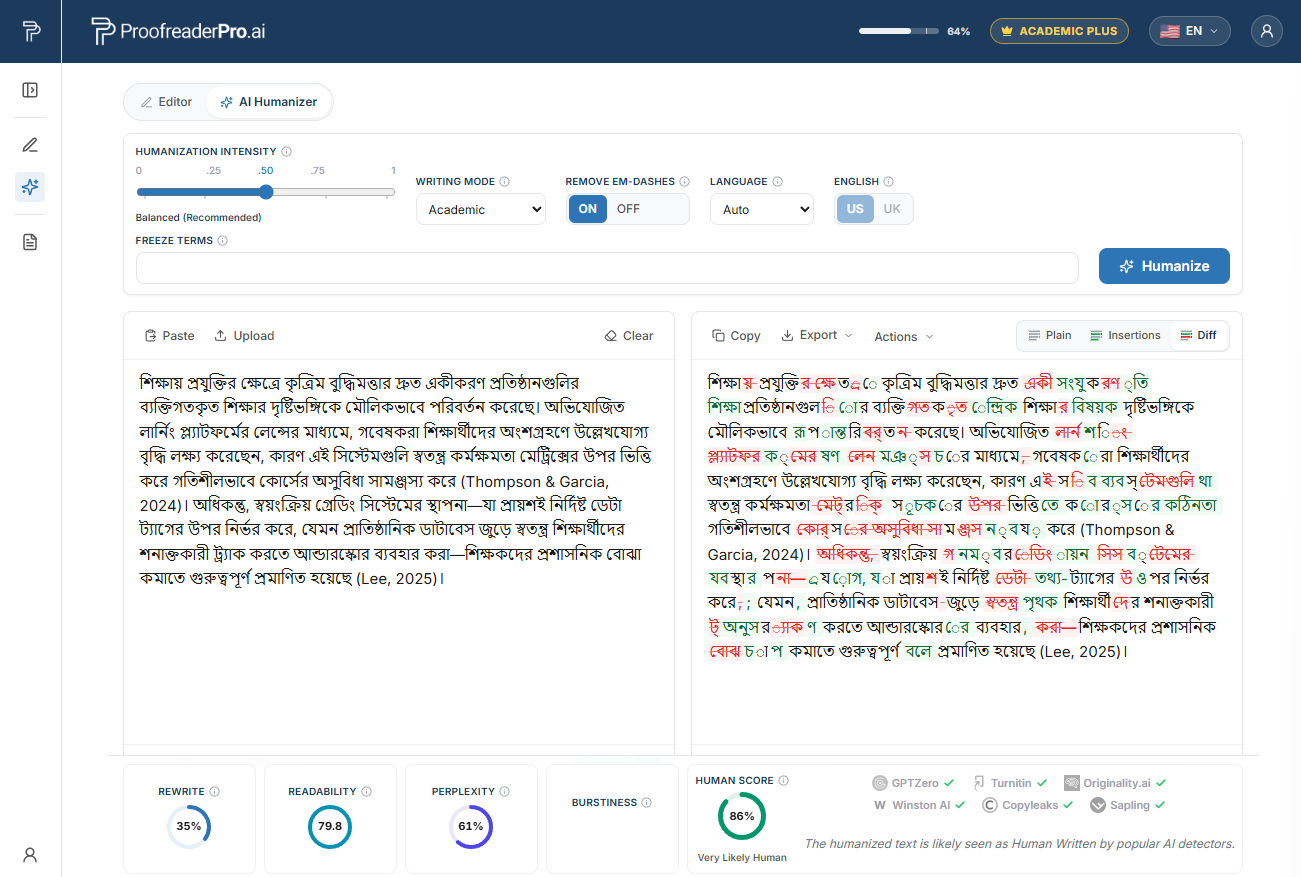
The ProofreaderPro AI Humanizer rewriting Bengali academic text. The before and after diff keeps your meaning and citations, and the detector checks confirm a natural, human read.
Why Bangladeshi researchers get flagged by AI detectors
In 2023, Stanford researchers led by Weixin Liang published a study in the Cell Press journal Patterns titled "GPT detectors are biased against non-native English writers." They ran human-written TOEFL essays through seven widely used detectors. On average, about 61% of the non-native essays were flagged as AI, against about 5% for native English writers. Nearly one in five non-native essays, roughly 19.8%, was unanimously flagged by every detector. Every single essay was written by a human.
The cause is a metric called perplexity. Many detectors score how surprising each word choice is to a language model. When you write carefully in a second language, you reach for common words and standard, predictable phrasing. That produces low perplexity, and low perplexity reads as machine text. The habits that make Bangladeshi academic prose clear and correct are precisely the habits these tools were trained to punish.
Read the full mechanism in our explainer on why AI detectors flag non-native English writers. The short version: a detector score is a claim to contest, not a verdict to accept.
The Bengali first-language patterns behind false flags
Bengali is an Indo-Aryan language whose structure diverges from English in well-documented ways. The transfer patterns below are not signs of weak English. They are systematic, careful constructions, and that very regularity is what a detector reads as low-perplexity, machine-like text.
Article handling. Bengali has no article system at all: no direct equivalent of "the," "a," or "an." Research on Bengali-English writing finds that article omission accounts for about 30.93% of errors and unnecessary insertion for about 26.25%, together more than half of all grammatical slips. When a writer overcorrects into a uniform, tidy article pattern, the prose becomes statistically smooth, exactly the surface a detector associates with generated text.
Prepositions from postposition transfer. Bengali places particles after the noun ("tebiler upore" maps to "table on-top-of"), so writers standardize English prepositions in consistent, safe ways. Consistency is good grammar and, unfortunately, a low-perplexity signal.
SOV word order residue. Bengali follows Subject-Object-Verb order ("Ami boi porlam" means "I book read"). Advanced writers suppress overt SOV, but they compensate with even, measured clause rhythm. That evenness flattens the burstiness detectors expect from human prose.
Copula patterns. Bengali often drops the copula ("Se shikkhok" is a full sentence for "She is a teacher"). Writers who train themselves to insert every "is," "are," "was," and "were" tend to produce uniform, textbook-clean sentence frames, again reading as predictable to a model.
Each of these is correct, deliberate writing. The problem is not your English. The problem is a detector that mistakes carefulness for automation.
Bangladesh's AI-detection and Turnitin context
Theses, dissertations, and journal submissions in Bangladesh are commonly screened with Turnitin or iThenticate for both similarity and AI indicators. Under the University Grants Commission (UGC) promotion framework, faculty must publish steadily in Scopus-indexed and Web of Science-indexed journals, so most researchers meet these checks repeatedly across a career, not once.
It's worth knowing how contested these AI scores already are. Vanderbilt disabled Turnitin's AI detector in 2023, citing false positives and bias against non-native writers. Michigan State, UT Austin, Northwestern, Pittsburgh, SMU, and Waterloo took similar steps. Turnitin itself suppresses scores in the 1 to 19% range (showing an asterisk rather than a number) and warns that its score should not be used alone for integrity decisions.
None of this means a flag is harmless. A supervisor or editor may still act on one. It means the right response is to make careful non-native writing less likely to be misread in the first place, and then to disclose your AI use openly, rather than to argue after the fact.
Protect your Bangladeshi research from false AI flags
Humanize your own AI-assisted draft, keep your meaning and citations intact, then disclose your AI use the way your journal requires. Tested against the major detectors, with high grammar accuracy.
Try the Humanizer FreeTop Bangladesh universities and where AI checks appear
Research output concentrates in a relatively small set of institutions, all operating under UGC's publication-based promotion criteria, and all screening theses and manuscripts for similarity and AI indicators.
- University of Dhaka (DU / ঢাকা বিশ্ববিদ্যালয়), Dhaka. The oldest and highest-ranked university, strong in natural sciences, pharmacy, and social sciences.
- Bangladesh University of Engineering and Technology (BUET / বুয়েট), Dhaka. The premier engineering institution, leading in civil, electrical, computer, and chemical engineering.
- BRAC University, Dhaka. A leading private university with strong output in public health, development studies, and computer science.
- North South University, Dhaka. The country's first private university, with growing research in business, engineering, and health sciences.
- University of Rajshahi, Rajshahi. The second-oldest university (established 1953), strong in applied sciences, agriculture, and humanities.
- University of Chittagong, Chittagong. A major public university with strengths in marine science, forestry, and social sciences.
- Jahangirnagar University, Savar, Dhaka. Known for biodiversity research, physics, and mathematics.
- Khulna University of Engineering and Technology (KUET), Khulna. Growing engineering output in civil, mechanical, and electrical fields.
- Bangladesh Agricultural University (BAU), Mymensingh. The premier agricultural research institution, leading in crop science, veterinary medicine, and fisheries.
- Daffodil International University, Dhaka. A high-output private university across computing, engineering, and health sciences.
- Chittagong University of Engineering and Technology (CUET), Chittagong. Strong engineering research with a growing international collaboration network.
- American International University-Bangladesh (AIUB), Dhaka. A private university with notable output in engineering, computer science, and business.
At every one of these institutions, the same reality holds: your manuscript passes an AI check before a human decides its fate. Protecting careful writing at that gate is a practical necessity, not a shortcut.
How the AI humanizer for Bangladeshi researchers works
The AI humanizer for Bangladeshi researchers follows a workflow, and the order matters.
First, draft. If your reasoning flows more naturally in Bengali, write it in Bengali and translate, or draft directly in English with an AI assistant to break the blank-page barrier. Second, proofread the grammar, because a humanizer is not a grammar checker. Third, run your own AI-assisted prose through the text humanizer. It varies rhythm and word choice, breaks repetitive cadence, and removes stray em dashes, while preserving your meaning, your technical terminology, and every citation exactly as written.
Our humanizer reworks AI text into a more natural human form that reads as human across Turnitin, Originality.ai, and GPTZero, while keeping grammar accuracy high on academic text. We do not guarantee these results but they come from testing. Please note that detectors retrain every few months, so we never promise "100% undetectable" and we never frame this as a way to bypass anything.
Then comes the step that keeps you inside the rules: disclose your AI use in the format your institution and target journal require. Humanizing your own draft to survive a biased detector is fair. Hiding fabricated work is not, and that is not what this tool is for. This is the same principle behind academic editing for Bangladeshi researchers, the editing counterpart to this guide, and it sits inside our wider multilingual AI humanizer hub covering researchers in dozens of countries.
Local funding bodies, journals, and AI-disclosure expectations
Research funding in Bangladesh flows mainly through the University Grants Commission (UGC), university internal grants and research cells, the Bangladesh Academy of Sciences, and international development partners. The Ministry of Education and the Ministry of Science and Technology both encourage international publication as part of the Vision 2041 development strategy, even though national R&D spending stays below 0.5% of GDP. When budgets are that tight, every desk rejection on language grounds wastes scarce funding, which is exactly why language protection is an efficiency measure, not a luxury.
On the journal side, Bangladesh hosts a growing landscape indexed through BanglaJOL (Bangladesh Journals Online), which lists 142 national journals. Prominent titles include the Journal of Health, Population, and Nutrition (Q1 ranked, the country's highest-impact journal), the Journal of Naval Architecture and Marine Engineering (Q2, published by BUET), Bangladesh Journal of Pharmacology, Bangladesh Journal of Medical Science, the Journal of Bangladesh Academy of Sciences, and the Dhaka University Journal of Science. Alongside these, the indexed international targets under UGC criteria remain Scopus and Web of Science.
Funders and journals increasingly ask authors to state whether and how they used AI tools. Treat that request as normal and answer it plainly. A clear disclosure line, combined with a humanized draft that reads like the careful researcher you are, is the combination that keeps you both credible and compliant. If a flag still lands, our humanizer preserves the clear paper trail you need to respond, and you can run every revision through the text humanizer without a per-word charge stacking up.
Frequently asked questions
Q: Does the AI humanizer for Bangladeshi researchers help my paper pass Turnitin?
Tested against the major detectors, our humanizer rewrites AI text into a more natural human form, which lowers the AI signal and improves its odds against tough detectors. Those are testing results, not guarantees, because detectors retrain every few months. The goal is to stop careful Bengali-influenced English from being misread, not to promise any fixed score.
Q: Is using an AI humanizer on my own draft considered cheating?
No, as long as you are humanizing your own AI-assisted writing, keeping your real findings and citations, and then disclosing your AI use the way your institution and journal require. The tool is built to protect genuine non-native writing from biased detectors, not to hide fabricated or borrowed work.
Q: Will the humanizer change my citations or technical terms?
No. It preserves your meaning, your discipline-specific terminology, and your references (APA, MLA, Chicago, IEEE) exactly as you wrote them. It varies rhythm and word choice and removes repetitive cadence, so the argument stays yours while the prose reads more naturally.
Q: Why do Bangladeshi researchers get flagged more often than native speakers?
A 2023 Stanford study found that detectors flagged about 61% of human-written non-native essays as AI, versus about 5% for native writers, because careful second-language prose has low perplexity. Bengali features such as article-free grammar and even, standardized phrasing make your writing predictable to a model, which the detector mistakes for automation.
Q: Does the humanizer work for text drafted in Bengali?
Yes. It supports Bengali (বাংলা) and more than 60 languages through a language-aware model. If you draft in Bengali and translate to English, or write directly in English with AI help, you can humanize the result while keeping structure and meaning intact.
Keep your meaning and citations, smooth the careful non-native patterns that trip AI detectors, then disclose your AI use. Tested against Turnitin, GPTZero, and Originality.ai, with high grammar accuracy.

Moe is an NLP engineer with a PhD in natural language processing. His research covers computational linguistics, text analysis, and machine learning, and it fed directly into the editing and humanization models behind ProofreaderPro. He writes about the part of the process most people never see: how a language model reads a sentence, scores it, and decides what to change.