AI Humanizer for Cover Letters and Resumes: Sound Like You
An AI humanizer for cover letters and resumes turns generic AI drafts into writing that sounds like you, reads human to recruiters, and stays ATS-safe. Free.

You told ChatGPT about the job, it gave you a polished cover letter in ten seconds, and you almost sent it. Then you read it back and realized it could have been written for anyone, about any role, at any company. That generic, eager, faintly robotic tone is exactly what a hiring manager reads fifty times a day, and it is the fastest way to get filed under maybe-later.
An AI humanizer for cover letters fixes the tone without making you start over. It takes the competent but anonymous draft and rewrites it so it sounds like a specific person who actually wants this specific job, while keeping the facts, dates, and titles you cannot afford to get wrong. Used well, it is the difference between a letter that reads like a template and one that reads like you.
This guide covers the whole job-application stack: the cover letter, the resume or CV, and your LinkedIn profile. The goal is not to trick anyone. It is to sound, on paper, like the person you already are in the room.
How ProofreaderPro humanizes your cover letter
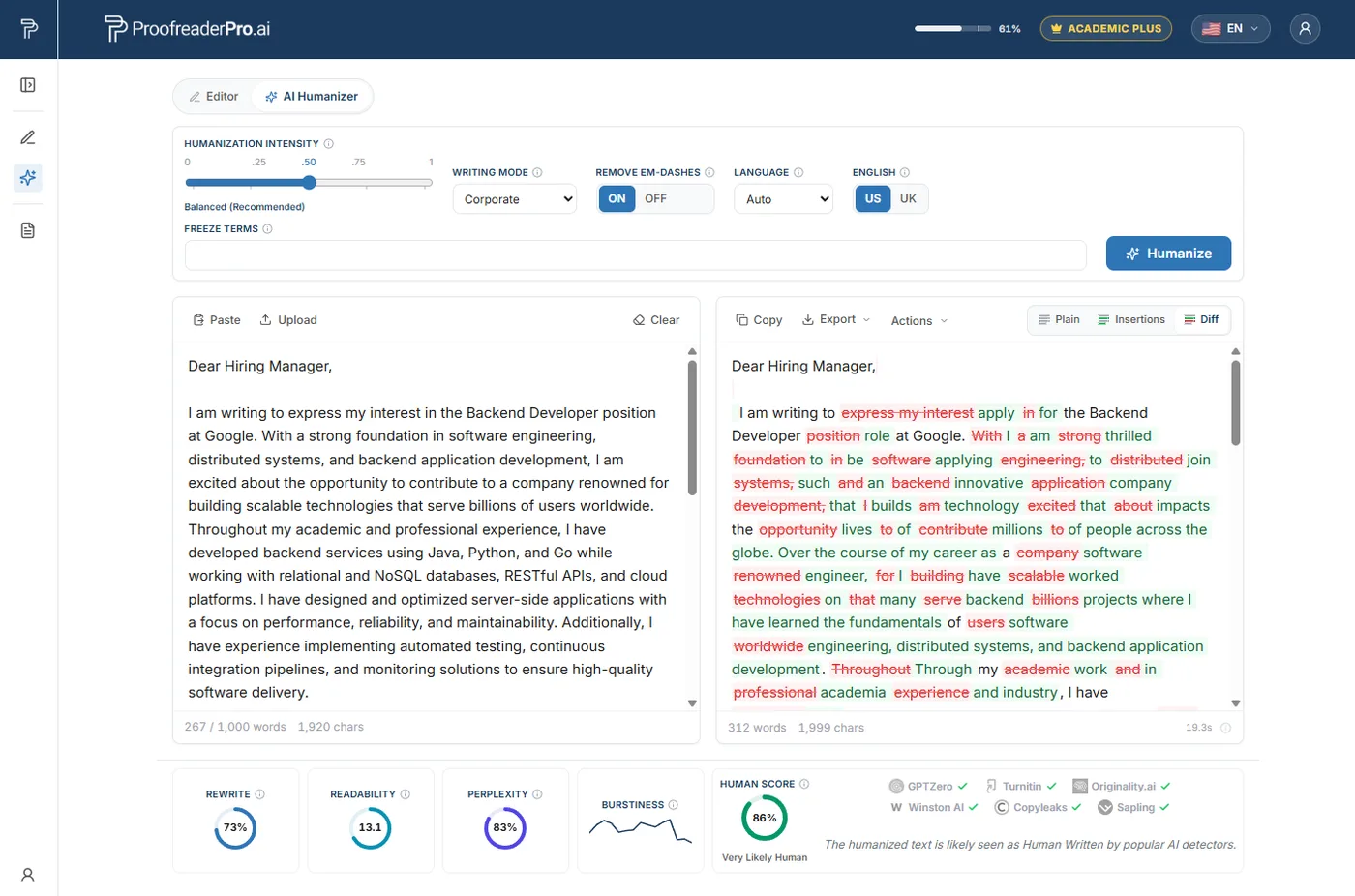
A cover letter from an AI arrives generic and eager, the same template thousands of other applicants are sending that week. ProofreaderPro's Corporate mode reworks it toward something a specific person clearly wrote for a specific job. It replaces the throat-clearing opener ("I am writing to express my keen interest") with a real hook, trims the stacked buzzwords down to one concrete accomplishment, and shifts the letter toward a warm, professional voice instead of a flat one.
On a resume it does the same for your bullets, while treating the exact skill terms from the job description as protected text, so the rewrite is built to read naturally to a recruiter and still parse cleanly for an applicant tracking system. Your name, the company, dates, and job titles are meant to stay where you put them. What changes is the impression, from a letter that looks auto-generated to one that sounds like you genuinely want the role.
Why AI cover letters get spotted, and rejected
Recruiters have read thousands of cover letters, and a growing share of them now arrive sounding identical. The tells are consistent. There is the throat-clearing opener ("I am writing to express my keen interest in..."), the buzzword pileup ("results-driven, detail-oriented, passionate team player"), the paragraph that just restates your resume, and the flat, even rhythm that never sounds like a real voice. None of this is against any rule. It is just forgettable, and forgettable loses.
The deeper problem is what a generic letter signals: that you did not care enough to make it specific. When every applicant sends the same model's output, the letter that sounds like a person with a genuine reason to want the role stands out by sheer contrast. That contrast is the whole opportunity.
Some employers now run applications through AI-detection tools too, though this is far from universal and the tools are imperfect. The more reliable filter is human. A recruiter does not need software to feel that a letter is hollow. Either way the fix is the same: make it read like you wrote it, because in the version that works, you did.
What an AI humanizer for cover letters actually does
A humanizer built for this is not a synonym spinner. It rewrites the rhythm, structure, and register of an AI draft so it reads like natural human writing, while protecting the details a job application lives or dies on: your name, the company, job titles, dates, and the specific skills you are claiming. A random word-swapper will happily turn "managed a team of six" into something vaguer, and vague is fatal on an application.
Our own AI humanizer does this with a register you control. A cover letter wants a warmer corporate voice; a resume wants tight and factual. It has been tested against Turnitin, GPTZero, Copyleaks, ZeroGPT, and Originality.ai, and keeps grammar above 96 percent, so the human voice it produces holds up even if an employer does screen for AI. Here is the real before and after.
| Your application | Raw AI draft | Humanized |
|---|---|---|
| Opening line | "I am writing to express my keen interest" | A specific hook about the role |
| Voice | Generic, eager, interchangeable | Yours, with a real reason to apply |
| Buzzwords | Piled on | Cut for concrete detail |
| Names, dates, titles | Sometimes garbled by spinners | Preserved intact |
| Reads to a recruiter like | A template everyone sent | A person they want to meet |
The AI phrases to cut from your cover letter first
If you do nothing else, hunt down these tells and rewrite them, because they are the ones a recruiter's eye snags on instantly.
- "I am writing to express my keen interest in..." The most common AI opener there is. Replace it with a specific line about the role or the company that only you would write.
- "Results-driven, detail-oriented, passionate team player." Stacked adjectives prove nothing. Swap the whole pile for one concrete result you actually delivered.
- "I am confident that my skills and experience make me an ideal candidate." Empty by design. Show the fit with an example instead of asserting it.
- "In today's fast-paced, ever-evolving landscape..." Filler that says nothing about you or the job. Cut it entirely.
- "I would welcome the opportunity to further discuss how I can contribute." A closing every model writes. End on something specific instead, like what you would tackle first in the role.
None of these are wrong, exactly. They are just what everyone else submits, which makes them invisible. Rewriting them into your own specifics is most of what humanizing a cover letter really means.
Humanize your cover letter so it sounds like you
ProofreaderPro.ai rewrites generic AI drafts into a natural, specific voice while your names, dates, and job titles stay intact. Tested against five detectors, with a free tier and no card required.
Try ProofreaderPro.ai FreeKeep it ATS-safe: resumes and CVs
Resumes add a wrinkle cover letters do not: the applicant tracking system, or ATS, that scans your resume before a human ever sees it. An ATS is not an AI detector. It matches keywords and parses formatting, which means humanizing a resume comes with one hard rule: keep the exact terms from the job description that you legitimately match.
So when you humanize resume bullets, protect your keywords the way you would in an SEO article. If the posting asks for "project management" and you have done it, that phrase stays verbatim even as you rewrite the sentence around it into something less robotic. Enter your target terms as protected keywords, rewrite for a human voice, and you get bullets that read naturally to the recruiter and still parse for the software. The same keyword protection that keeps a humanized SEO article ranking keeps a humanized resume matching.
One resume-specific caution: never let a rewrite inflate a title or a number. "Assisted with" must not become "led," and "six" must not drift to "a dozen." A humanizer should change how your experience reads, never what it claims.
Humanize your LinkedIn profile too
Your LinkedIn About section and headline are cover letters that work while you sleep, and they suffer the same generic-AI problem. A summary that opens with "As a dynamic professional passionate about leveraging synergies" tells every recruiter who lands on your profile that a model wrote it. Run it through the humanizer and it becomes a summary that sounds like a person describing their actual work.
The move is the same across the profile. Humanize the About section, the headline, and your role descriptions into a voice that sounds like you, keep the skills and keywords recruiters search for, and cut the buzzwords that make everyone sound the same. A profile that reads human is a profile people actually finish.
How to humanize your cover letter, step by step
Start from a draft you can stand behind, then edit in order.
1. Give the AI real material first. Before you humanize anything, feed the model your actual details: the specific role, why you want it, one concrete accomplishment. A specific draft humanizes better than a hollow one.
2. Paste it in and pick a corporate voice. Drop the draft into the humanizer and choose the register that fits a cover letter, warm but professional. For the mechanics of that register, our guide on humanizing AI business writing goes deeper.
3. Protect your names and details. Enter the company name, the role, and any exact skills as protected terms so the rewrite cannot garble them.
4. Humanize, then read it aloud. The read-aloud test is brutal and revealing. Any sentence that makes you cringe is one a recruiter would cringe at too. Cut it or rewrite it.
5. Add the one thing AI cannot. A real detail only you know: why this company, a specific project of theirs, what you would do first. That sentence is what turns a humanized letter into a hired one.
If you would rather learn the manual moves, our companion guide on how to make AI writing sound human lists techniques you can apply by hand, and our straight take on whether AI humanizers actually work explains what to expect from any of them.
Frequently asked questions
Q: Can recruiters tell if my cover letter was written by AI?
Often, yes, and usually not from a tool but from the tone. Generic openers, stacked buzzwords, and a flat rhythm read as machine-written to anyone who screens applications all day. Some employers also run AI-detection software, though it is imperfect and not universal. Either way, a letter humanized into your own specific voice is the reliable fix.
Q: Is it OK to use AI to write my cover letter?
Yes, as long as the result is genuinely your own. Using AI to draft and then editing it into your voice with your real experience is no different from asking a friend to help you word something. The line you should not cross is claiming skills or results you do not have. A humanizer changes how your letter reads, not the facts you are responsible for.
Q: Will humanizing my resume break the ATS keywords?
Not if you protect them. An applicant tracking system matches keywords and formatting, so enter the exact terms from the job description that you legitimately match as protected keywords before you humanize. The rewrite then improves the voice around those terms while leaving the terms themselves intact.
Q: How do I make my ChatGPT cover letter sound more human?
Give it specific material before you humanize, then rewrite the generic openers, cut the buzzwords, and read it aloud to catch flat phrasing. Add at least one detail only you would know, like why this company or a specific project of theirs. A humanizer built for a corporate voice handles the mechanical part while you supply the specifics.
Q: Can an AI humanizer help with my LinkedIn profile?
Yes. Your About section, headline, and role descriptions have the same generic-AI problem as a cover letter, and the same fix. Humanize them into a natural voice, keep the skills and keywords recruiters search for, and cut the buzzwords so the profile sounds like a real person.
Q: Does a humanized cover letter still pass AI detection?
It reads far more like human writing, which is what most screening actually comes down to. Our humanizer is tested against Turnitin, GPTZero, Copyleaks, ZeroGPT, and Originality.ai, but no tool can promise a specific result, and detectors change constantly. Aim for a letter that genuinely sounds like you, which is the version that holds up whether a person or a tool reads it.
Turn generic AI drafts into cover letters, resumes, and profiles that sound like you, while your names, dates, and titles stay intact.

Moe is an NLP engineer with a PhD in natural language processing. His research covers computational linguistics, text analysis, and machine learning, and it fed directly into the editing and humanization models behind ProofreaderPro. He writes about the part of the process most people never see: how a language model reads a sentence, scores it, and decides what to change.