How to Humanize AI Research Papers, Theses and Dissertations
Humanize an AI research paper, thesis, or dissertation without breaking a citation or changing a result. A section-by-section method for researchers. Try it free.

You used AI to help draft parts of your paper. Maybe it tightened a clumsy methods paragraph, or turned your bullet-point results into flowing sentences, or gave you a first pass at a discussion when you were staring at a blank page. That is a legitimate way to work, and most journals now allow it with disclosure.
Humanizing an AI research paper means taking that helped draft and making it truly yours again. It's not about hiding cheating or aiming for a magic detector score. It's about putting back the voice, tone, and care you brought to the paper in the first place, with all of the citations and technical terms in their correct places. Done well, it'll actually make your paper stronger (not just quieter to a detector).
This is harder than it sounds, because a research paper is the worst possible place for a careless rewrite. One swapped term or moved citation can change what your evidence claims. The method matters. Below is how we approach it, section by section, with meaning and attribution protected at every step.
How ProofreaderPro humanizes your research paper
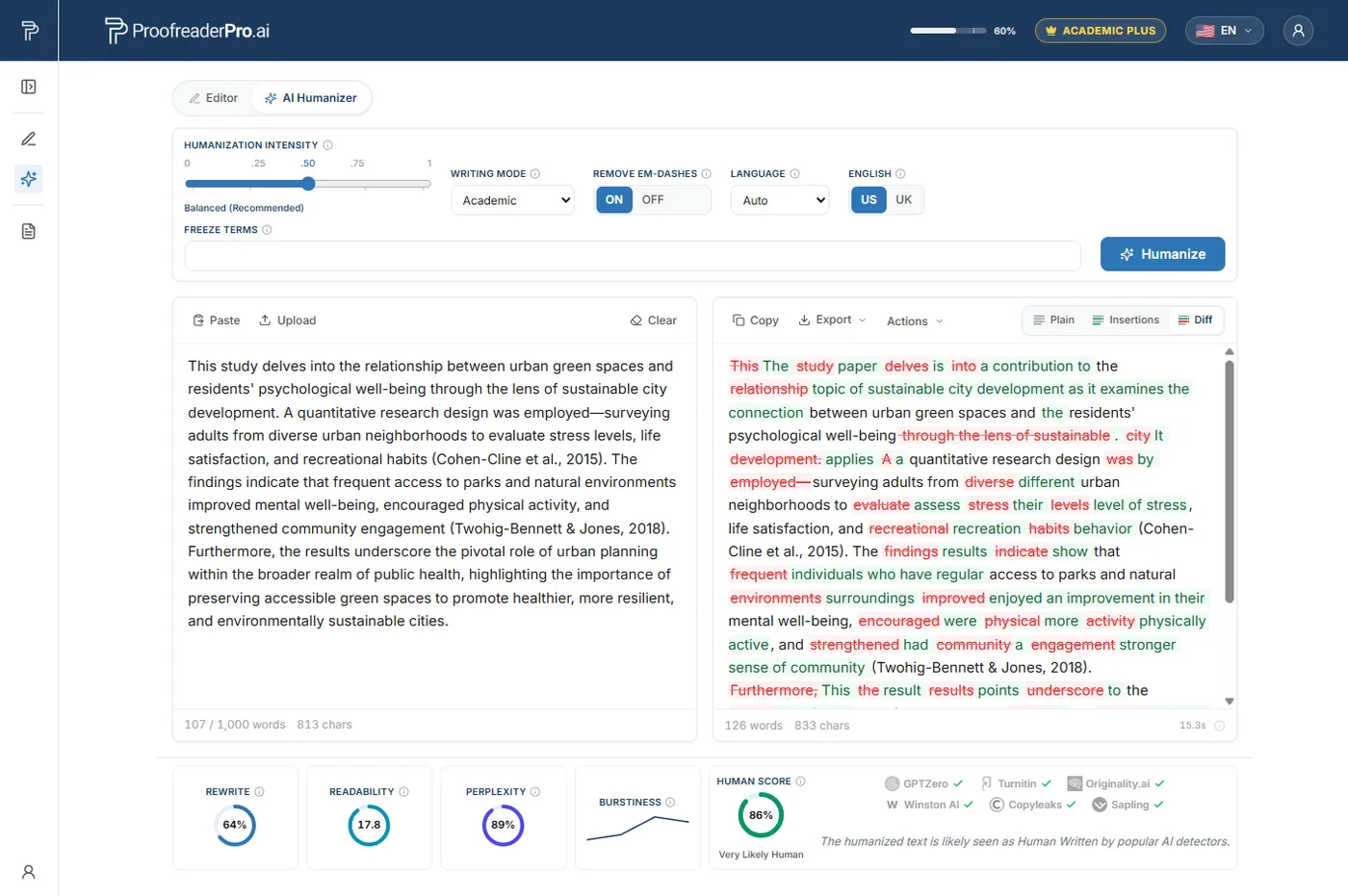
Straight from a model, academic prose tends to read smooth and evenly weighted, the flat register a reviewer notices quickly. ProofreaderPro's Academic mode works through a paper section by section, reworking the framing and rhythm so the writing sounds like a researcher rather than a template. It varies sentence length, eases the over-confident phrasing a model reaches for, and works to restore the careful hedging ("suggests," "is associated with") that generic drafts tend to harden into false certainty.
While it changes the wording and structure, it is designed to preserve the parts a paper depends on. It aims to keep your citations, numbers, statistical terms, and results as you wrote them, so the meaning stays put while the phrasing becomes more natural. What you get back is closer to your own scholarly voice than the anonymous register a model defaults to.
What it means to humanize an AI research paper
AI models write in a recognizable way. The sentences are smooth and evenly weighted, the vocabulary is generic, and the rhythm barely changes from line to line. Detectors call this low burstiness and low perplexity, but you do not need the jargon to feel it. It reads as flat.
Humanizing fixes the flatness by putting your judgment back into the prose. That means adding the emphasis that matters to your argument where the model wrote a neutral summary. It means calibrating the claim to what your data actually supports where the model hedged too little or too much. The goal is writing that sounds like a careful researcher thought it through, because you did.
What humanizing should never do is alter your findings. A rewrite that changes a p-value, softens a limitation, or overstates an effect has not helped you, it has introduced an error into the scientific record. This is the line that separates an academic humanizer from a generic one. Our text humanizer treats citations, statistics, and technical terms as protected elements, so the language around your evidence changes while the evidence itself does not.
One more reason to work carefully: non-native English writers are flagged far more than native speakers. In a study published in 2023 in the journal Patterns, researchers examined essays written by non-native and native English writers who took a standardized English proficiency test. They found that while seven detectors flagged about 61 percent of non-native English test essays as AI (and about 5 percent for native writers), it was mostly because their simple vocabulary was viewed as too predictable. If English is your second language, humanizing your own writing into confident, natural prose is partly about undoing that bias, not hiding anything.
Step 1: Work section by section
Do not paste the whole manuscript at once. Each part of a paper has a different voice, and a good rewrite respects that. Your methods should stay precise and impersonal. Your discussion can carry more of your interpretation and argument. Feeding everything through in one block flattens these differences.
Start with the methods. This is where generic humanizers do the most damage, because they treat instrument names, reagents, and statistical tests as ordinary words to swap. Rewrite for clarity and flow, but keep every procedure verbatim. If the draft says "multicollinearity," it must not become "multiple connections."
Then the results. Numbers, units, and directions of effect are sacred here. Humanize the framing sentences that introduce and connect your findings, and leave the reported values untouched. Read each rewritten sentence against your data table to confirm nothing drifted.
Finish with the introduction and discussion. These sections carry the most of your voice, so they benefit most from humanizing. This is where you argue, contextualize, and hedge, and where flat AI phrasing is most obvious to a reviewer.
Step 2: Protect citations and technical terms
Citations are the single most common casualty of automated rewriting.
Generic humanizers see a citation like "(Smith et al., 2024)" as a block of text to be messed up somehow, whether by reformatting it, moving it to the wrong clause, or forgetting the year. In a paper with eighty in-text citations, that is hours of work and a real risk of accidentally giving credit to the wrong person. Placing citations is not an art project. It is a way to guide the reader through the maze of statements you have made and the evidence you have presented for them.
Freeze your terminology before you rewrite. Make a short list of the terms that must not change: your key variables, your methods, your discipline-specific vocabulary. An academic-grade tool recognizes citation styles like APA, MLA, Chicago, IEEE, and Turabian and holds them in place automatically, which is the whole reason we built citation protection into the humanizer that preserves citations rather than bolting it on later.
Verify after every pass. Even careful tools occasionally rephrase a term they should have left alone. Check your citations against your reference list and confirm your key terms survived. A tracked-changes view makes this fast, because you see exactly what moved and can reject anything you do not like.
Step 3: Restore hedging, voice, and disclosure
Good research writing hedges. It says "these results suggest" rather than "these results prove," and that calibration is part of your credibility. AI drafts often flatten hedging into either false confidence or vague mush, so restoring it is one of the highest-value edits you can make.
Read your rewritten sections aloud. Where a claim sounds stronger than your evidence, pull it back. Where you buried your actual contribution under cautious throat-clearing, sharpen it. This is the part no tool can do for you, because only you know what the study can and cannot claim.
Then disclose. Most universities and journals (including Elsevier and Springer) now expect an AI-use statement if you've used AI to help draft text. Disclosure is not an admission of wrongdoing, it is the thing that makes the whole workflow legitimate. Humanizing your own helped draft and disclosing the assistance is genuine scholarship. Hiding it isn't, no matter how low the score.
It also helps to be clear about what humanizers can and cannot do. They reliably improve weak, robotic phrasing and reduce false positives on genuine writing. They cannot guarantee a specific detector result, because detectors change constantly and the strongest ones increasingly catch machine-rewritten text. Aim for a paper you would be comfortable defending, not a number on a dashboard.
Humanize research writing without breaking a citation
An academic-grade humanizer that protects your citations, statistics, and terminology while it refines your voice. Tested against five detectors, offered with tracked-changes review.
Try ProofreaderPro.ai FreeHow much of a paper should you humanize?
Only the parts an AI actually helped write.
If you wrote your methods yourself and you just used AI to smooth out the discussion, humanize the discussion and leave your own prose alone. If you run clean human writing through any rewriter, it runs the risk of introducing errors into your text.
For a section that is heavily AI-drafted, expect to spend real time in review rather than accepting the output wholesale. The same discipline applies to a citation-dense synthesis like a review of the literature, which we cover in our guide to humanize an AI-drafted literature review. For the general technique across any document, our walkthrough on how to humanize AI text covers the fundamentals.
The plain summary: humanizing is editing, not laundering. It makes your legitimately assisted draft read like you, protects your evidence, and pairs with disclosure. That is a workflow you can defend to any committee.
Humanizing a thesis or dissertation, chapter by chapter
A thesis or dissertation raises the stakes on everything above, because the document is long, the voice has to stay consistent across chapters written months apart, and a committee reads it slowly. If you leaned on AI to draft a literature chapter in September and a discussion in March, the two can read like two different authors, and that seam is exactly what a careful examiner notices.
Treat it the way you treated the paper, only more so. Humanize one chapter at a time, and never run the whole manuscript through a rewriter in a single pass. Your methods chapter should keep its precise, impersonal register. Your discussion and conclusion carry your argument and deserve the most of your voice. The real trick with a long document is consistency: decide how formal you sound, how much you hedge, and which terms you always use, then hold that standard from the first chapter to the last.
Length also means more citations, and more places for an automated tool to drop a year or move a reference to the wrong clause. Verify in sections rather than trusting one final sweep, and keep your reference manager open while you review. For researchers, academics, and PhDs working at this scale, the discipline is the same as a paper applied with more patience: change the rhythm and the voice, protect the evidence, and read every chapter against what your data and sources actually say.
A worked example: one results paragraph, humanized
Method advice is easier to trust when you can see it applied. Here is a short results passage of the kind an AI assistant tends to produce, followed by the version we would actually submit. The passage is invented, but the failure pattern is exactly what we see in real drafts.
Before (AI-typical): "The proposed model demonstrates a robust improvement in classification accuracy, achieving 94.2% across the benchmark datasets. This substantial gain underscores the effectiveness of the attention mechanism and highlights its broad applicability to real tasks. These findings confirm the superiority of the approach (Chen et al., 2024)."
After (humanized and edited): "Our model reached 94.2% classification accuracy on the benchmark datasets, the highest of the systems we compared. We think the attention mechanism drives most of that gain, though we have not isolated it fully, so we treat the result as promising rather than settled. It is consistent with Chen et al. (2024), who reported a similar pattern for attention-based models."
The sentences now vary. The original runs three medium clauses at the same even pace, which is exactly the low-variation rhythm detectors read as machine-written. The edit mixes a longer sentence with a shorter, hedged one. That lift in sentence-length variation is what people mean by burstiness, and it also raises perplexity, because the word choices are less predictable than the model's defaults.
The hedging is back. "Demonstrates", "confirm the superiority", and "broad applicability" claim more than four datasets can support. Real researchers hedge: "we think", "not isolated it fully", "promising rather than settled". A reviewer notices overclaiming faster than any detector does. That caution is genuine, and it happens to look nothing like the flat confidence of a generated draft.
The load-bearing details survive. This is the part generic tools break. The number 94.2% is untouched. The citation stays attached to the same claim, moved to a narrative form (Chen et al., 2024 becomes Chen et al. (2024)) without dropping the year or the author. "Classification accuracy" and "attention mechanism" are kept as written, because swapping them for near-synonyms would quietly change the science.
Two signals improve at once here: the passage reads as yours, and it carries less of the statistical texture detectors flag. That is the whole point. We built ProofreaderPro.ai to make this trade without you babysitting every number and reference, but the same logic works by hand. Change the rhythm and the voice, protect the evidence, and never let a lower score cost you a citation or a result. Aim for a draft you would be comfortable explaining out loud.
Frequently asked questions
Q: How do I humanize an AI-assisted research paper?
Work section by section, rewriting for your own voice and emphasis while keeping numbers, terms, and citations exactly as they were. Restore proper hedging so claims match your evidence, then verify every citation against your reference list. An academic humanizer speeds this up by protecting your terminology, but a manual review pass is still essential.
Q: Will humanizing change my citations?
A generic humanizer often will, because it treats citations as ordinary text to reshuffle. An academic-grade tool recognizes styles like APA, IEEE, and Chicago and holds them in place, so your attributions stay put. Always confirm your citations after any rewrite, since even good tools occasionally slip.
Q: Is it ethical to humanize a research paper?
Yes, when you are humanizing your own legitimately AI-assisted draft so it reads in your voice, and when you disclose the AI use your journal or university requires. That is normal editing. It becomes misconduct only if you use it to misrepresent authorship or hide AI generation your policy does not allow.
Q: How much of a paper should be humanized?
Only the parts an AI actually helped you write. Leave sections you drafted yourself untouched, since running clean human prose through a rewriter can introduce errors and even make it look more artificial. Focus the tool where the machine phrasing actually is.
Q: Which sections of a research paper are most likely to be flagged as AI?
The formulaic sections get flagged most: the abstract, the methods, and boilerplate parts of the results, where the writing is naturally uniform and low in burstiness. Introductions and discussions tend to draw fewer flags, because they carry more of your own argument and voice. When you humanize an AI research paper, spend your effort where the prose is flattest, and leave equations, data, and citations untouched.
Q: Should I disclose AI use after humanizing my research paper?
Yes. Humanizing changes how the writing sounds, not the fact that you used AI to help draft it, so most journals and universities still expect a short disclosure. State which tool you used and for what (drafting, editing, or translation), and keep your citations and results exactly as your data supports them.
Q: Can I humanize an entire thesis or dissertation?
Yes, but do it chapter by chapter rather than in one pass, and keep your voice consistent across chapters written months apart. Verify citations in sections, since a long document has far more references for a rewriter to disturb. Humanize only the parts AI actually helped you draft, and leave chapters you wrote yourself alone.
Q: Is there an AI humanizer built for academic writing?
Yes. A general humanizer swaps synonyms and can mangle a defined term or move a citation, which is the last thing academic writing can afford. An academic-grade humanizer protects your citations, statistics, and terminology while it refines your voice across papers, theses, and dissertations. That is the mode we built ProofreaderPro.ai around, tested against Turnitin, GPTZero, Copyleaks, ZeroGPT, and Originality.ai.
Refine AI-assisted drafts while your citations, statistics, and technical terms stay protected.

Moe is an NLP engineer with a PhD in natural language processing. His research covers computational linguistics, text analysis, and machine learning, and it fed directly into the editing and humanization models behind ProofreaderPro. He writes about the part of the process most people never see: how a language model reads a sentence, scores it, and decides what to change.