AI Humanizer for ESL Researchers: Fix False Flags
AI humanizer for ESL researchers: the Stanford bias evidence, why detectors flag your English, and how to fix false flags responsibly. Try it free.

You wrote every word of your literature review. English is your second, maybe your third language, and you worked hard on it. Then a detector, or a professor using one, told you the text was likely AI. The accusation lands twice as hard when it is wrong, and harder still when the tool making it has a known blind spot for writers like you.
This is that blind spot that leads many non-native scholars to search for an AI humanizer for ESL researchers. They might be trying to correct a false flag on something they wrote themselves. Or maybe they used an AI assistant to help smooth out their English, which is legit, but now need the rough draft to read in their own voice. These are real situations. And we owe them a straight answer.
This is a guide to the evidence, the reasons behind it, and the steps that actually help. It is written by people who build an academic humanizer and proofreader, and who think this bias is a genuine fairness problem, not a marketing opportunity.
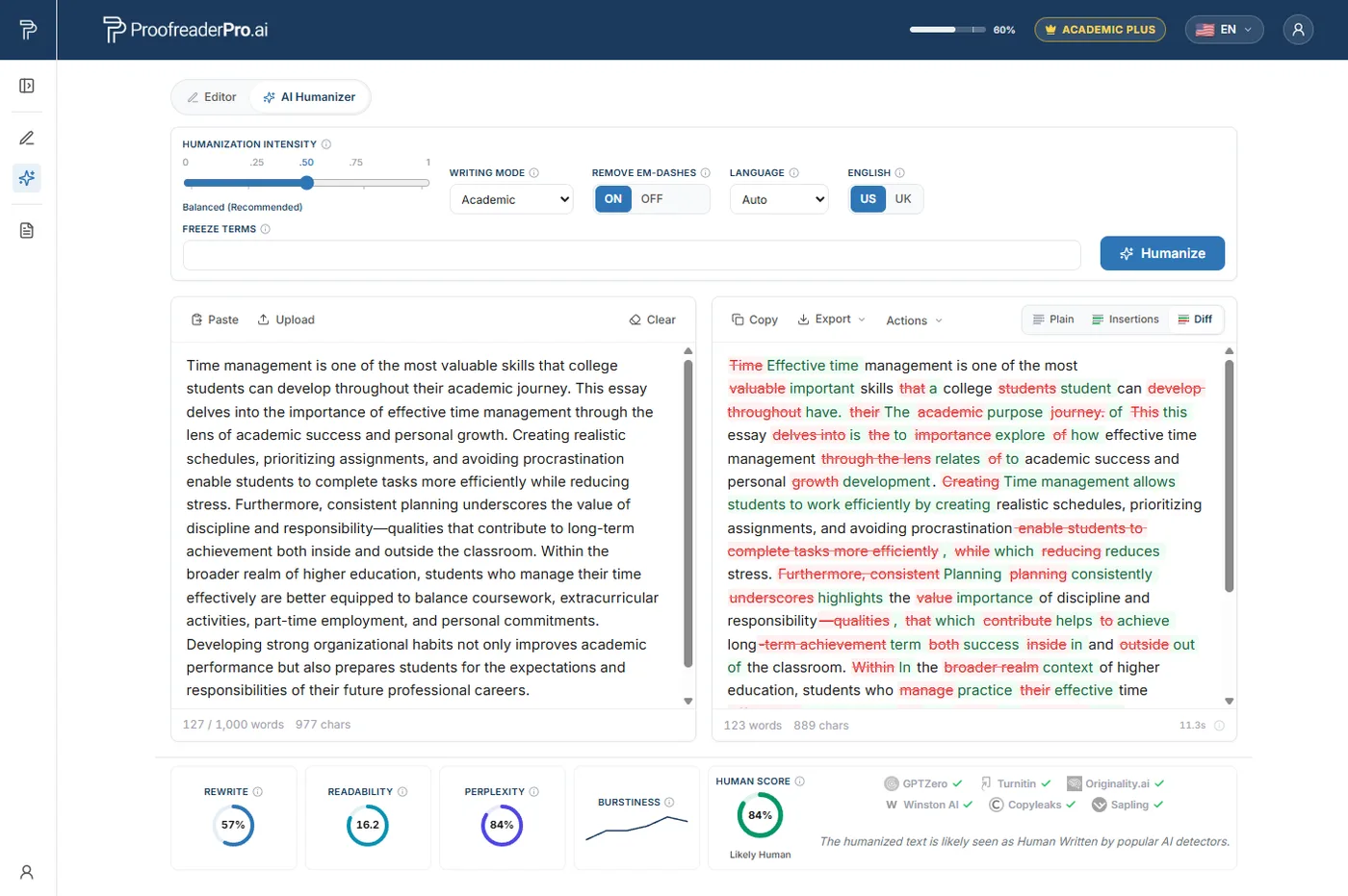
How ProofreaderPro humanizes your translated AI writing
When you draft in your first language and lean on AI to translate or smooth your English, the result often comes back stiff and over-careful, technically correct but not quite how a confident writer would put it. ProofreaderPro's Academic mode reworks that text toward natural, fluent English that still sounds like you. It adds the sentence-to-sentence variation careful non-native writing tends to lose and replaces awkward literal phrasings with what a fluent academic would more likely write.
It also resists inflating your vocabulary into something ornate, since plain, clear wording is a strength rather than a weakness. As the phrasing improves, it works to keep your citations, technical terms, numbers, and the meaning of every claim intact, so your argument does not drift. The goal is straightforward: writing that reads as clearly and confidently as the ideas behind it, in your own academic voice.
The evidence: AI detectors are biased against non-native writers
The clearest finding here is not an opinion, it is peer-reviewed. In 2023, a Stanford research team published "GPT detectors are biased against non-native English writers" in the journal Patterns, part of Cell Press. They ran a set of TOEFL essays written by non-native English speakers through seven widely used AI detectors.
On average, they flagged around 61% of those human-written essays as AI. Almost one in five (about 19.8%) was unanimously flagged by all the detectors in the group. For those written by native English speakers, they flagged only around 5%. Same task, same detectors, wildly different treatment based on the writer's first language.
That gap is the single most citable piece of fairness evidence in this whole debate, and it should change how much weight anyone puts on a detector score. We unpack the mechanics in our explainer on why AI detectors flag non-native writers, but the short version is that the tools are measuring the wrong thing.
Why it happens: perplexity punishes simpler English
Detectors do not read for meaning. They measure statistical texture. Two of the main signals are perplexity, roughly how surprising each next word is, and burstiness, how much sentence length and rhythm vary across a passage.
Writing by fluent native speakers tends to run high on both. It wanders, it varies, it reaches for the less predictable word. AI writing tends to be smooth and evenly weighted, which reads as low perplexity.
Here is the unfair part. Careful non-native English is often smooth and predictable too. You reach for the reliable word rather than the flashy one, you keep sentences clean, you avoid idioms you are not fully sure of. That is good, clear writing. To a detector tuned on perplexity, it looks like the machine. The Stanford team found exactly this pattern: the misclassified essays had lower perplexity, driven by simpler vocabulary. You are being penalized for writing plainly and well.
What to do if a detector wrongly flags your writing
First, do not panic, and do not treat a flag as the final word. Turnitin itself says its score should not be the sole basis for any penalty, and a growing list of universities agree with that caution in practice.
Vanderbilt disabled Turnitin's AI detector back in 2023, noting that even a claimed false-positive rate of 1% across tens of thousands of submissions could still wrongly accuse hundreds of students, and citing bias against non-native English writers. In 2025, the University of Waterloo followed suit when it turned out that human-written text was flagged as 100% AI. You are not the first person to hit this wall, and institutions are moving in your direction.
The courts are noticing too. In a case reported in February 2026, a student at Adelphi University had an essay flagged as 100% AI; a federal judge found that finding "without merit" and ordered it removed from his record. If you are facing a flag on work you genuinely wrote, you have more standing than you think. Our guide on how to appeal a false AI-detection flag walks through documenting your writing process and responding calmly.
How an AI humanizer for ESL researchers actually helps
Now the real part about what a humanizer does and does not do, because this is where the marketing tends to overpromise.
If you wrote the text yourself and were falsely flagged, the real remedy is the appeal above, not a rewrite. You should not have to launder your own genuine writing to satisfy a biased tool, and we will never tell you otherwise.
Where an AI text humanizer genuinely helps is the very common case where you used an AI assistant legitimately, to help draft or smooth your English, and now need the text to read in your own academic voice rather than a generic machine register. That is editing your own work, and it is precisely what the tool is built for.
It preserves your meaning and citations. An academic-tuned humanizer keeps APA, MLA, Chicago, IEEE, and Turabian references in place and protects technical terms and numbers, so your argument does not drift while the phrasing becomes more natural.
It adds variation without adding errors. Pairing the humanizer with our AI proofreader, which reaches grammar accuracy above 96%, helps your English read as confident and varied rather than flat, which is the exact texture that low-perplexity flags react to, while keeping your voice.
We report results plainly. We test our academic mode against Turnitin, GPTZero, Copyleaks, ZeroGPT, and Originality.ai, and it clears the major detectors most of the time in our own testing. We call those tested figures, not guarantees, because detectors change constantly and no one can promise a score.
Write Confident Academic English as a Non-Native Researcher
Turn legitimately AI-assisted drafts into natural academic English while preserving your citations, terminology, and meaning. Tested against five detectors.
Try ProofreaderPro.ai FreeWrite in confident English, and disclose
The durable goal here is not a lower number. It is writing you are proud to put your name on, in English that sounds like you at your most careful and clear.
If it helps you get there, use an AI assistant, just as you would use a dictionary or a fluent colleague reading over your shoulder. Make sure that your text sounds like you; humanize it. If you need to, proofread it to make sure the grammar is clean and the tone is confident. Then follow your journal or university policy about disclosing your use of AI, which is increasingly a formal requirement rather than a courtesy.
The combination of real quality and full disclosure works very well for you compared to trying to hit a magic score. That is actually what will survive the next detector update, the real thing. The fairness of these tools is improving slowly. Until it arrives, write well, document your process, and do not let a biased number define your work.
A pre-submission checklist for ESL researchers
The sections above explain the bias and the responsible fix. This is the short, practical list we hand non-native colleagues before they submit AI-assisted work. None of it is about tricking a detector. All of it is about protecting writing you did yourself. Work through it in order.
Set your baseline before anyone else does. Run your finished draft through one or two detectors yourself, so a later flag is something you already understand instead of a shock in your professor's office. It also gives you a calm reference point if the number changes later.
Humanize in short passes, then reread for meaning. Rewrite a paragraph or two at a time and check that every number, hedge, and claim survived, because one silent swap can turn a statistically significant reduction into a real difference.
Lock your citations and key terms first. Freeze your in-text references and field vocabulary before you rewrite, so a general tool cannot drop an author name or replace a technical term with a loose synonym. Reference formatting is one of the first things a general humanizer breaks.
Keep your natural register. Do not let a tool inflate plain words into ornate ones to game a score, because stilted vocabulary reads as less human, not more, and that is exactly the pattern that flags non-native writers. Write the way you actually speak in your field.
Run a clarity pass after you humanize, not before. A rewrite can introduce small article or agreement errors, so a final proofreading pass catches anything it broke and keeps your English clean. For ESL writers this last pass matters most, since detectors already over-flag simpler English.
Keep a record of how you wrote it. Save version history, notes, and outlines, because detection is shifting toward writing-process transparency, and your drafting trail is becoming the strongest proof of authorship. Tools like Turnitin Clarity and Grammarly Authorship now track how a document was written.
Test against the detector your institution actually uses. A green result in a humanizer's built-in checker means little if your department grades with Turnitin, which added dedicated humanizer detection in August 2025. Match your self-test to the tool that will actually grade you.
Do not chase a zero. No credible tool can guarantee a 0% score, detectors disagree and update often, and aiming for genuine clarity in your own voice protects you better than any number ever will. Our academic humanizer is tested against Turnitin, GPTZero, Copyleaks, ZeroGPT, and Originality.ai, but we still tell you the same thing.
Frequently asked questions
Q: Are AI detectors biased against non-native English speakers?
Yes, and the evidence is peer-reviewed. A 2023 Stanford study in the journal Patterns found that seven AI detectors flagged about 61% of human-written TOEFL essays by non-native speakers as AI, versus roughly 5% for native writers. The bias is real, documented, and a strong reason not to treat a detector score as proof of anything.
Q: Why do detectors flag my writing when I wrote it?
Detectors measure statistical texture like perplexity, not authorship. Clear, careful non-native English often uses simpler, more predictable word choices, which reads to a detector as low perplexity, the same signal AI tends to produce. You are being penalized for writing plainly, not for cheating.
Q: How can ESL researchers avoid false AI flags?
If you were flagged on your own writing, keep your drafts and version history and appeal, since the documented bias gives you real standing. If you used AI assistance legitimately, an AI humanizer for ESL researchers can help the draft read in your natural voice, and a proofreader adds clean variation. Always disclose your AI use per your institution's policy.
Q: Does an AI humanizer help ESL writers?
It helps most when you used an AI assistant to draft or smooth your English and want the result to read in your own academic voice while keeping citations and meaning intact. It is not a way to launder genuine writing that was wrongly flagged; that calls for an appeal. Used on your own AI-assisted work with disclosure, it is a legitimate editing step.
Q: Is it cheating for ESL researchers to use an AI humanizer?
It depends on why you use it. Correcting a false flag on writing you did yourself, or smoothing your own English so it reads naturally, is a legitimate use of an AI humanizer for ESL researchers, especially when you disclose any AI help per your journal or university policy. Using one to disguise who actually wrote the work is not, and no tool changes that line.
Q: Which AI detectors are worst for non-native English writers?
No detector is bias-free, but independent tests report higher false-positive rates on non-native English for tools like Copyleaks, Winston AI, and Sapling. A peer-reviewed Stanford study found that seven detectors flagged around 61% of non-native TOEFL essays as AI, compared with about 5% for native writers. Treat any single score as a prompt to review your work, not as proof of anything.
Humanize legitimately AI-assisted drafts into confident, natural academic English while preserving citations and meaning.

Moe is an NLP engineer with a PhD in natural language processing. His research covers computational linguistics, text analysis, and machine learning, and it fed directly into the editing and humanization models behind ProofreaderPro. He writes about the part of the process most people never see: how a language model reads a sentence, scores it, and decides what to change.