AI Humanizer for Students: Humanize Essays, Assignments and Homework
An AI humanizer for students should make your essays and assignments sound like you, not cheat for you. The ethical way to humanize and disclose. Free.

You wrote the essay. Most of it, anyway. You leaned on ChatGPT to unstick one stubborn paragraph, to smooth a clumsy sentence, maybe to turn a page of messy notes into something that reads in order. Then you looked at the finished draft and realized it no longer sounds like you. It sounds like a corporate memo, and now you're nervous that a detector will flag work you actually did.
An AI humanizer for students is usually marketed as the fix: paste your text, get a lower AI score, submit. That's exactly what gets people into trouble. The version of this tool worth using does something smaller and far more defensible. It helps an AI-helped draft sound like you again, brings your own rhythm back, and keeps your meaning intact so the argument you built does not quietly change.
This guide is about that narrower use. Not passing off a machine's work as your own, but editing writing you are responsible for, keeping it in your voice, and disclosing your AI use the way your school asks. Aiming for a flawless zero on a detector is the wrong target, and the reasons why will probably surprise you.
How ProofreaderPro humanizes your college essay
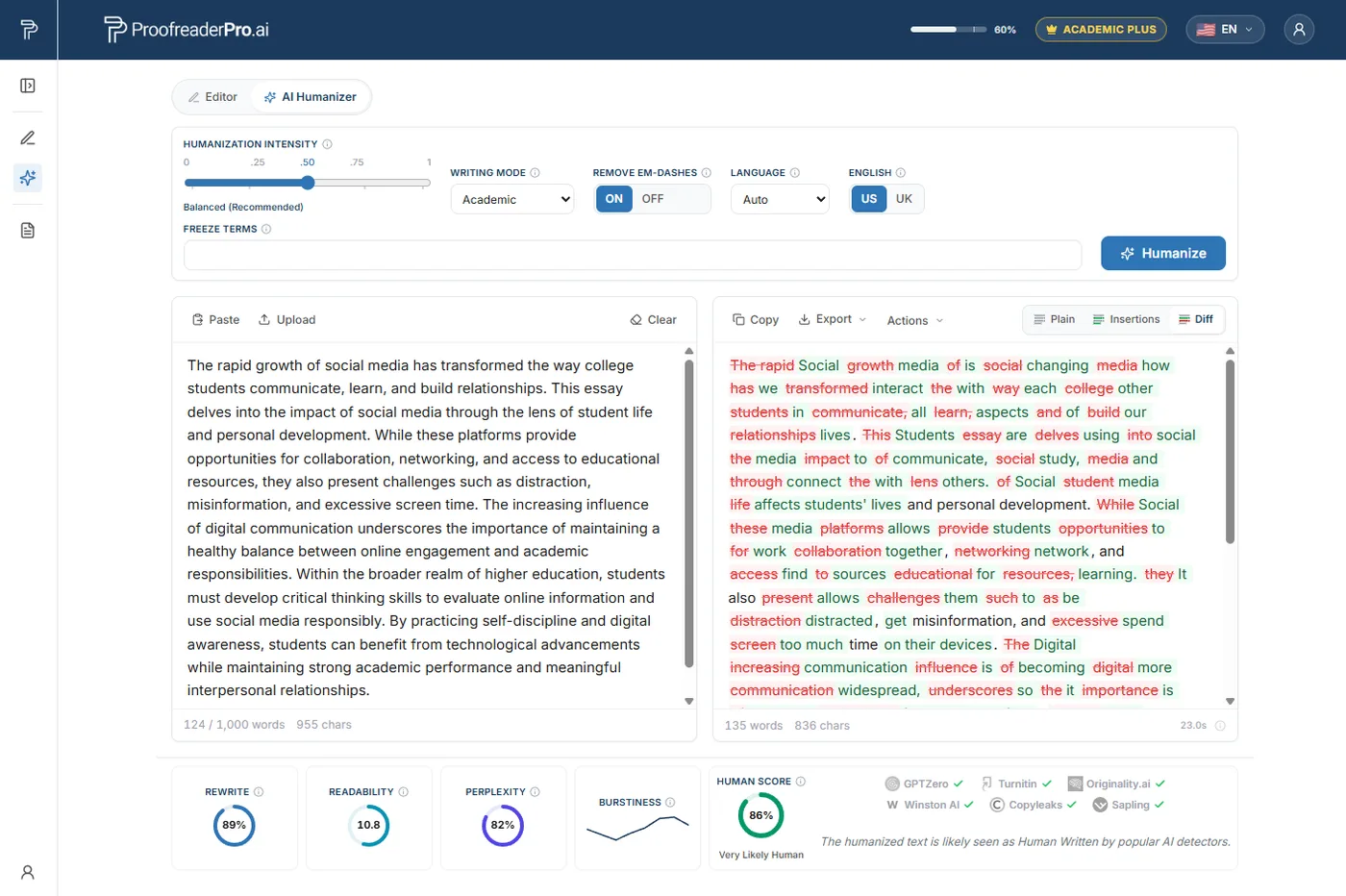
An essay straight from ChatGPT tends to read like a corporate memo: smooth, generic, and evenly paced in a way an instructor recognizes before any tool is involved. ProofreaderPro's Academic mode reworks that draft toward something that sounds like you. It varies your sentence length so the rhythm stops feeling uniform, trades the stock connective phrases a model overuses for plainer transitions, and leaves room for the specific example or point only you would make.
It also adapts to the task, since a formal essay and a weekly discussion post call for a different register. As it rewrites, it is designed to leave the parts you are accountable for in place, so your quotations, page numbers, citations, and the claims you are making are meant to stay as you set them. You end up with an assignment that reads in your own voice and still says what you meant.
What an AI humanizer for students actually does
Strip away the marketing and the job is plain. A humanizer takes overwrought, overly smooth writing and makes it read more like a person wrote it: with sentences of varying lengths, simpler connective tissue, less of the tics that language models fall into. It is an editing step, just like a grammar check or a paraphrase, when used well.
The distinction that matters for you is whose ideas are on the page. If the argument, the evidence, and the structure are yours, running the prose through an AI text humanizer to restore your voice is editing. If a model produced the thinking and you are using a tool to hide that, no rewrite changes the fact that the work is not yours. Same button, very different act.
And a good academic humanizer protects the things a general rewriter breaks. It should leave your citations where you put them, keep technical terms exact, and hold your numbers steady. Ours is built around that: it preserves APA, MLA, Chicago, and IEEE citations, keeps your academic register, and is tested against Turnitin, GPTZero, Copyleaks, ZeroGPT, and Originality.ai rather than sold on a promise it cannot keep.
Where the line sits: help versus misconduct
Most universities have stopped pretending AI does not exist and now draw the line around authorship and disclosure. Using AI to help draft, then editing that draft into your own words and disclosing it, sits on the acceptable side almost everywhere. Submitting AI output as if you wrote it from scratch does not, and a humanizer cannot move you across that line. It only changes how the text reads, never who is accountable for it.
So the real test is simple. Could you explain and defend every claim in the essay without the model in front of you? If yes, you are editing your own work and a humanizer is a legitimate polish step. If no, the tool is helping you misrepresent authorship, and that is the definition most integrity offices use. We wrote a fuller breakdown of that boundary in is using an AI humanizer cheating.
Disclosure is the part students skip, and it is the cheapest insurance you have. Many programs now expect a short line noting where and how you used AI. A sentence in your methods or acknowledgements costs you nothing and takes the whole question of concealment off the table.
Why chasing a 0% score backfires
You will be tempted to keep running it through a humanizer over and over again until the meter says zero. This is where you do the most harm to your own work. With each harsh go-round, you lose nuance of language, chop up your sentences, and suck the unique detail right out of the prose. You can absolutely hit a low score and hand in something worse than the draft you started with.
There is a technical reason why zero is a mirage. If documents come in the range of 1-19 percent AI, then Turnitin does not even give a number. It suppresses it and displays it as an asterisk with no highlights, because there are so many false positives down there. An outcome below 20 percent already looks clean to an instructor. Grinding from 4 percent to 0 percent buys you nothing and risks a lot.
And the target keeps moving. Detectors update constantly. Turnitin added detection aimed particularly at paraphrased and humanized text across 2024 and 2025, so a trick that scores zero this month can light up next month. Betting your grade on staying ahead of that arms race is a poor wager. Writing something genuinely in your voice is the only version that keeps working.
Which college assignments can you humanize, and which you should not
"Essay" is the headline, but college throws a lot more than essays at you, and the same rule decides each one: humanize your own AI-assisted draft, never a machine's thinking passed off as yours.
Standard essays and papers. The classic case. If the argument and evidence are yours and AI only helped smooth the prose, humanizing it back into your voice is ordinary editing. This is where an AI humanizer for students earns its keep.
Weekly assignments and homework. Short response papers, problem write-ups, reading responses. These are low-stakes, but they are also where habits form, so use the tool to clean up phrasing you drafted, not to generate the answer for you.
Discussion posts and forum replies. These read as painfully robotic when they are generated, because everyone's AI reaches for the same phrasing and your instructor sees twenty near-identical posts. A quick humanizing pass on your own point makes it sound like you actually joined the conversation.
Short articles and blog assignments. Journalism, communications, and marketing courses often ask for article-style writing, where a flat AI voice is the whole problem. Humanizing gives it the personal cadence the assignment is really testing for.
Where to stop. Take-home exams, personal statements, and anything your instructor says must be written without AI. A humanizer cannot make prohibited AI use acceptable, and a personal statement is supposed to be unmistakably you from the first draft. When a specific assignment bans AI, no rewrite changes that.
The through-line is boring, but it protects you: the tool restores your voice on work you are responsible for. Whatever the format, keep your drafts, disclose what your course asks you to disclose, and read every changed line to be sure it still sounds like you and still says what you meant.
Humanize your essay in your own voice
ProofreaderPro.ai restores how you sound while keeping your citations and meaning intact, tested against Turnitin, GPTZero, Copyleaks, ZeroGPT, and Originality.ai. Start on the free tier.
Try ProofreaderPro.ai FreeIf a detector flagged you and you did write it
Plenty of students land here in reverse: you wrote the essay yourself and a detector called it AI anyway. This happens more than the tool vendors admit, and it's not your imagination. In early 2026 a federal judge reviewed a case where a student's essay was flagged as 100 percent AI, found the school's determination without merit, and ordered the finding removed from his record. A single detector score is not proof, and courts are starting to say so out loud.
The bias is worse if English is not your first language. A peer-reviewed study in the Cell Press journal Patterns found that seven detectors flagged roughly 61 percent of essays by non-native English writers as AI, against about 5 percent for native writers, largely because simpler, more predictable vocabulary reads as machine-like to these systems. If you write clean, plain English, you are statistically more likely to be wrongly accused.
If it happens to you, do not panic, and do not immediately run your own genuine work through a humanizer just to look less like a robot. Keep your drafts, your notes, and your version history, then follow a calm process. Our guide to appeal a false AI-detection flag walks through the evidence that actually persuades a committee.
How to humanize your essay so it still sounds like you
Start from a draft you can stand behind, then edit in this order. First, read the essay aloud; the sentences that make you stumble are usually the ones that read as machine-written. Second, put back the specifics a model tends to sand off: the actual study, the real number, the example from your own reading. Third, vary your sentence length on purpose, because uniform rhythm is one of the strongest AI tells.
Only then reach for a tool, and use it as a finishing pass rather than a first resort. A humanizer is good at the mechanical part, breaking up robotic cadence and trimming stock phrases, while you stay in charge of meaning. If you would rather learn the manual moves first, our companion guide on how to make AI writing sound human lists nine techniques you can apply by hand.
The last step is the one people skip: read the humanized version against your original and confirm it still says what you meant. Good editing makes the essay clearer and more like you. If a pass makes it vaguer or changes a claim, reject it. Your name is on the argument, so the argument has to stay yours.
A pre-submission checklist for your humanized essay
Before you touch a single tool, run through this list. It is what separates an edit that protects you from one that quietly creates a new problem the night before a deadline.
Read your course AI policy first. Rules vary by instructor and even by assignment, so confirm what your course allows before you rewrite, and read up on where editing ends and misconduct begins if you are unsure.
Keep your drafts and version history. Save your outline, notes, and the Word or Google Docs revision history, because a visible writing process is the strongest evidence that the work is yours.
Humanize one paragraph at a time. Working in small passes lets you catch a sentence that drifted off meaning, which is much harder to spot when you paste a whole essay at once.
Reread every changed sentence aloud. A quick read aloud exposes the flat, committee-written phrasing a rewrite can leave behind, and it flags anything that no longer sounds like you.
Protect your quotes and citations. Check that author names, page numbers, and direct quotations survived untouched, since a general rewriter can reword a quotation you are not allowed to alter.
Verify the facts after the rewrite. Confirm dates, figures, and key terms still say what you meant, because synonym-swapping tools can turn a precise word into one that means something slightly different.
Do not trust the tool's built-in checker alone. The score inside a humanizer is not the score your school will run, so treat that number as a rough hint rather than a verdict.
Write your AI disclosure in your own words. If your instructor asks how you used AI, a short clear statement protects you far more than any detector score. Our academic humanizer is built to keep your meaning and citations intact while you do exactly that.
Leave yourself a buffer before the deadline. Do this a day early so you have time to repair a rewrite that went sideways, instead of submitting a garbled paragraph at 11:59.
One quick note on scores before you submit. Our humanizer is tested against Turnitin, GPTZero, Copyleaks, ZeroGPT, and Originality.ai, and in our academic testing it clears the strongest detectors most of the time. No tool can promise a pass, detectors update constantly, and an essay that reads in your own voice is the only result that actually holds up when a person reads it closely.
Frequently asked questions
Q: Is using an AI humanizer for essays cheating?
It depends on whose work you are polishing. If the ideas, structure, and evidence are yours and you use an AI humanizer for students to restore your own voice, that is editing, and disclosing your AI use keeps you clear. If you are hiding that a model did the actual thinking, no rewrite makes that legitimate.
Q: How do I make my essay sound like me?
Read it aloud, add back your own specific examples and sources, and vary your sentence length so the rhythm stops feeling uniform. Then use a humanizer only as a finishing pass, and check that every edit still matches what you meant to say.
Q: Can students use AI humanizers responsibly?
Yes, when the tool edits your own legitimately AI-assisted draft rather than conceals authorship. Keep your drafts and version history, disclose your AI use per your school's policy, and treat the humanizer as one editing step alongside grammar and citation checks.
Q: Will humanizing my essay lower my grade?
It should not if you keep your meaning and voice intact; clearer, more natural prose usually helps. The risk comes from over-processing, where repeated aggressive passes flatten your vocabulary and drift from your argument, so review every change before you submit.
Q: Can my professor tell if I used an AI humanizer?
Sometimes. Turnitin added dedicated humanizer and bypasser detection in August 2025, and more schools now use writing-process tools like Turnitin Clarity and Grammarly Authorship that record how a document was actually written. The safer assumption is that heavy rewriting can be noticed, which is why we suggest humanizing your own draft lightly and keeping your version history.
Q: Do I need to disclose that I used an AI humanizer on my essay?
Follow your university or instructor policy, since disclosure rules differ from one course to the next. If you used AI to help draft or smooth your essay, a short statement of what you did is usually the responsible move, and it protects you better than a low detector score. Editing your own writing so it reads in your voice is normal, but transparency is what keeps it above board.
Q: Is there an AI humanizer for college essays specifically?
A good academic humanizer works for any college writing, from essays to weekly assignments to discussion posts, because the job is the same: restore your natural voice while keeping your quotes and citations intact. Choose one with an academic or student mode, work one section at a time, and disclose your AI use wherever your course requires it.
Restore your voice while your citations, terminology, and meaning stay exactly where you put them.

Moe is an NLP engineer with a PhD in natural language processing. His research covers computational linguistics, text analysis, and machine learning, and it fed directly into the editing and humanization models behind ProofreaderPro. He writes about the part of the process most people never see: how a language model reads a sentence, scores it, and decides what to change.